Market outlook
Rising Outlook 7/10
The Pokémon TCG market has shown consistent growth, especially for iconic Pokémon like Dragonite. Japanese 1st Edition cards are increasingly sought by international collectors, driving up prices.
Next months. Prices are expected to remain stable with modest increases over the next 3–6 months, driven by seasonal demand and collector activity.
Long term. Over 1–3 years, the card is likely to appreciate significantly as Japanese 1st Edition cards become more rare andCollector demand intensifies.
History
Dragonite is the evolved form of Dragonair, a powerful Dragon-type Pokémon known for its incredible flying speed and resilience. It is one of the most iconic and beloved Pokémon from Generation I, often associated with strength, wisdom, and the ability to traverse the skies effortlessly. In the Pokémon lore, it is said to be nearly invincible and can fly at speeds exceeding 10,000 km/h.
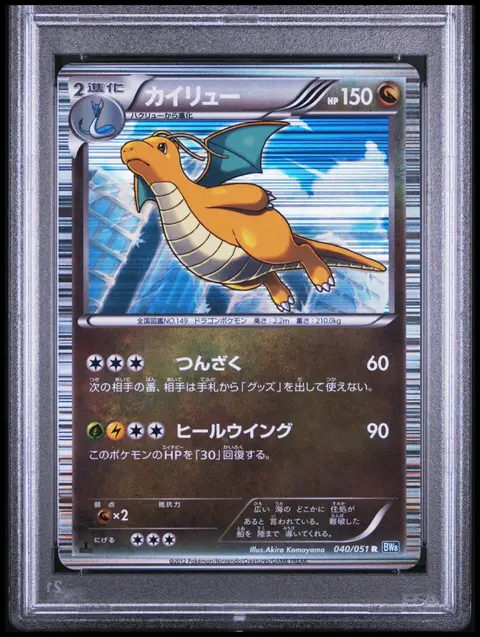
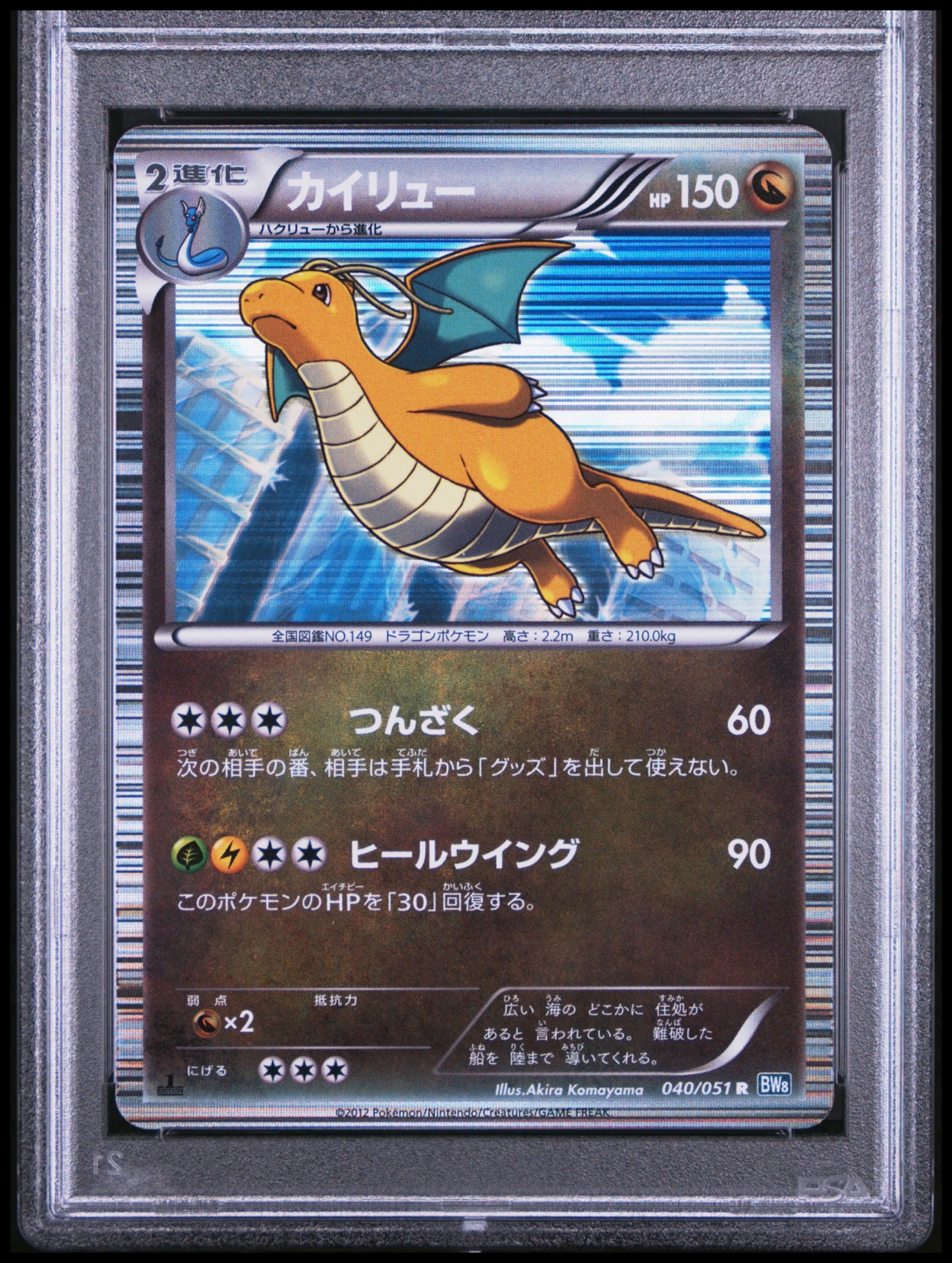
This specific Dragonite card (040/051) was first released in the Japanese 'Plasma Gale' set on September 14, 2012. It is part of the Black & White Series and features Team Plasma-themed Pokémon.
- The card is a 1st Edition instance of the Japanese 'Plasma Gale' set, released in 2012.
- Dragonite #40 is a Holo Rare card in the Thunder Knuckle dual expansion that corresponds to Plasma Gale.
- This card is not a Secret Rare but a standard Holo Rare within its set.
Rarity and print run
- Tier
- Rare
- Print run
- Medium
- First printed in
- Plasma Gale (Japanese Black & White Series)
- Demand
- High
- Supply
- Medium
- Japanese 1st Edition status adds scarcity compared to unlimited versions.
- Medium print run limits total availability.
- Dragonite's iconic status increases collector interest.
Collector notes
Condition. Key things to check include centering (especially for 1st Edition), surface scratches on the holographic layer, edge wear, and corner creasing. Common flaws include holographic dullness, whitening on edges, and minor surface scuffs. As a 1st Edition, the stamp must be clear and properly aligned.
Storage. Best practices include storing the card in a rigid top loader with a 1st Edition sleeve, then placing it in a sealed protective bag. For long-term value, consider grading (graded or graded) and storing in a climate-controlled environment away from direct sunlight.
Authenticity. To spot fakes, verify the holographic pattern matches the official design, check the 1st Edition stamp clarity and placement, and ensure the card stock and print quality are consistent with authentic Japanese Pokémon cards. Reprints often have duller holographics, incorrect fonts, or misaligned stamps. Authentication through graded or graded is recommended for high-value copies.
Sources: bulbapedia.bulbagarden.net, youtube.com, instagram.com, sportscardinvestor.com, pricecharting.com