Market outlook
Rising Outlook 7/10
The card benefits from steady Hall of Fame demand, the historical importance of Hank Aaron, and ongoing interest in vintage Topps flagship baseball issues. Because supply is fixed and high-grade examples are finite, well-graded copies are more likely to appreciate than lower-grade raw copies.[1][2][3]
Next months. Likely stable to modestly higher, with strongest performance in graded 7-8 and above examples.
Long term. Likely gradual appreciation over 1-3 years, especially for high-grade certified copies with strong centering and eye appeal.
History
Henry Louis Aaron, known as Hank Aaron and nicknamed 'Hammerin’ Hank,' was one of the greatest players in baseball history. He played in Major League Baseball from 1954 to 1976, spent most of his career with the Milwaukee/Atlanta Braves, and became baseball’s all-time home run leader with 755 career home runs. He was also a lifetime .305 hitter with 3,771 hits and, at retirement, held the record for most runs batted in, making him an all-around offensive legend rather than only a power hitter.[1]
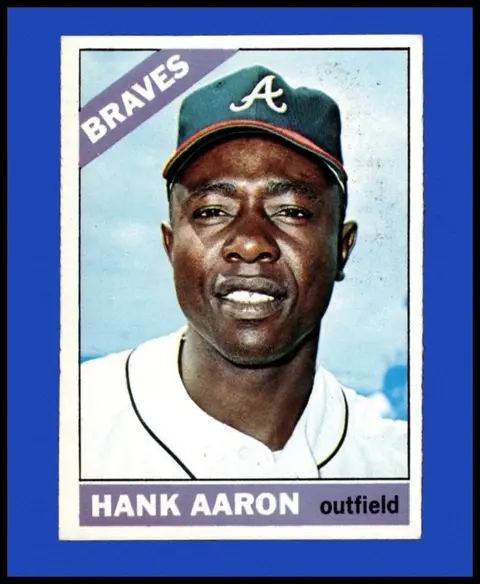
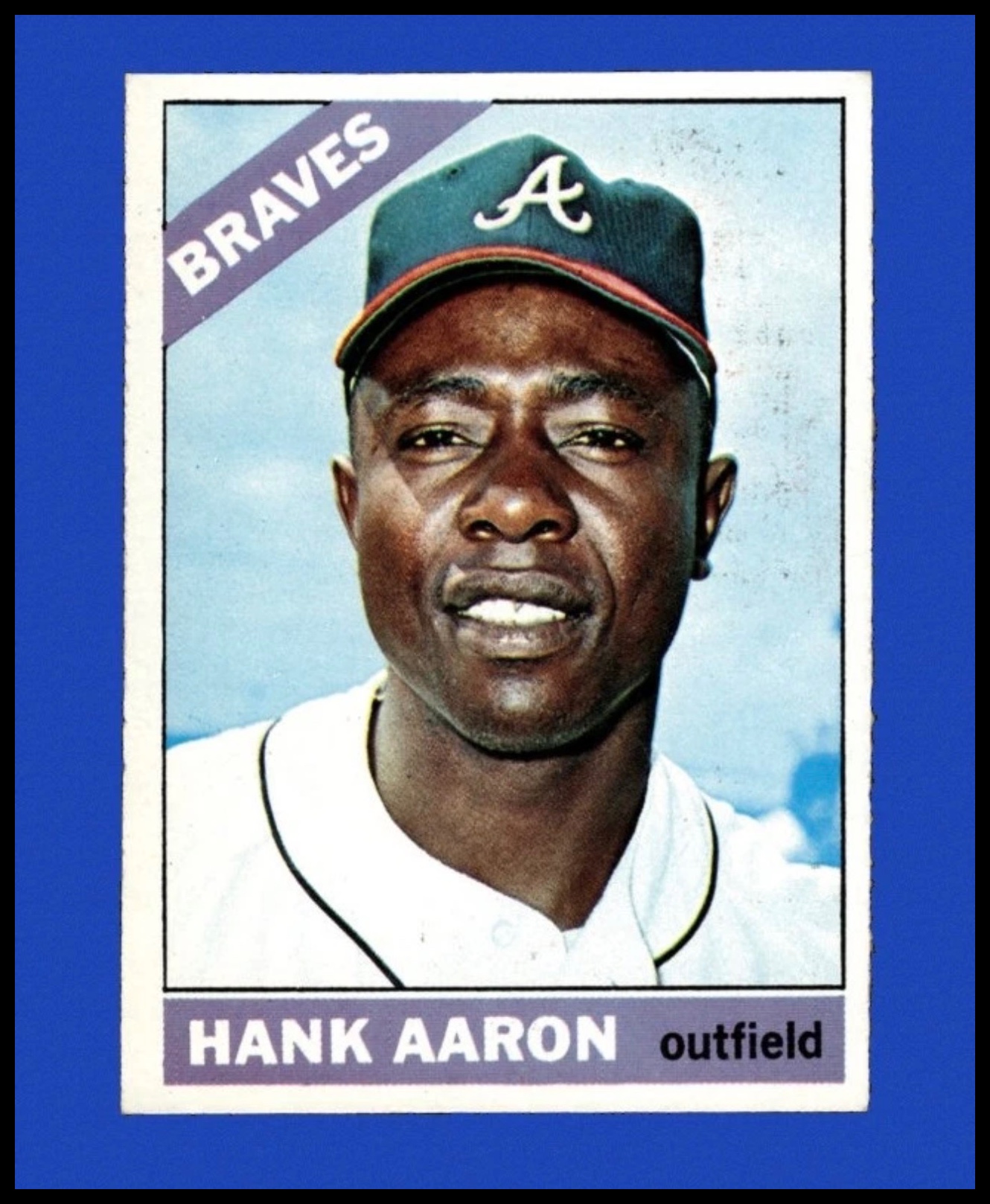
This card was first released in the 1966 Topps Baseball set, a standard mass-produced Topps issue distributed nationwide in the United States in 1966.[7][3]
- Card #500 is one of the key Hank Aaron mainstream base cards from the 1960s and is widely collected because it features one of the era’s greatest players.[1][7]
- The 1966 Topps Hank Aaron #500 is a base-card issue, not a short print, autograph, or special insert, which makes condition the main driver of value rather than rarity.[7][3]
- Modern market data shows strong demand in graded examples, with recent graded 8 sales reported around $1,400 to $2,013 depending on venue and timing.[2][8]
Collector notes
Condition. Check centering first, since 1960s Topps cards often have visible left-right and top-bottom centering issues. Also inspect corners for whitening, edge chipping, surface print wear, snowing, and any wax staining or gum/wax residue from pack storage. High-grade copies are especially sensitive to sharp corners, clean borders, and strong registration.[3][4]
Storage. Store in an inert penny sleeve and rigid top loader or semi-rigid holder, and keep the card in a cool, dry, low-light environment. For higher-value graded or raw copies, use a penny sleeve before sleeving into a rigid holder, and avoid bending pressure, humidity, and direct handling of the surface.[4][5]
Authenticity. 1966 Topps Aaron cards are commonly encountered as authentic originals because of the set’s high print volume, but buyers should still check paper stock, print dot pattern, border coloration, and reverse text clarity against known authentic examples. Reprints usually show softer print quality, overly bright white stock, or altered gloss; third-party grading is the best authentication route for higher-value copies.[1][3]