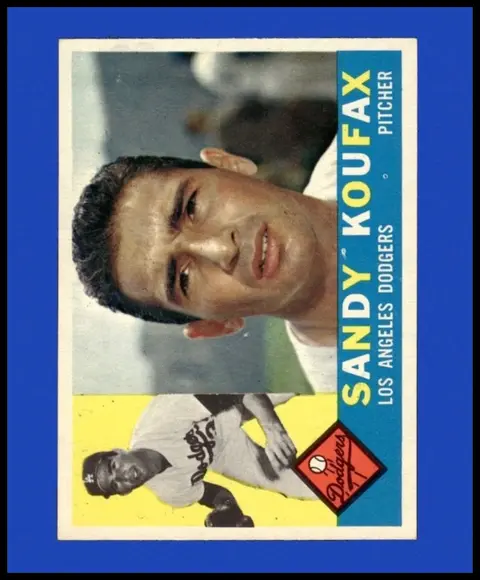
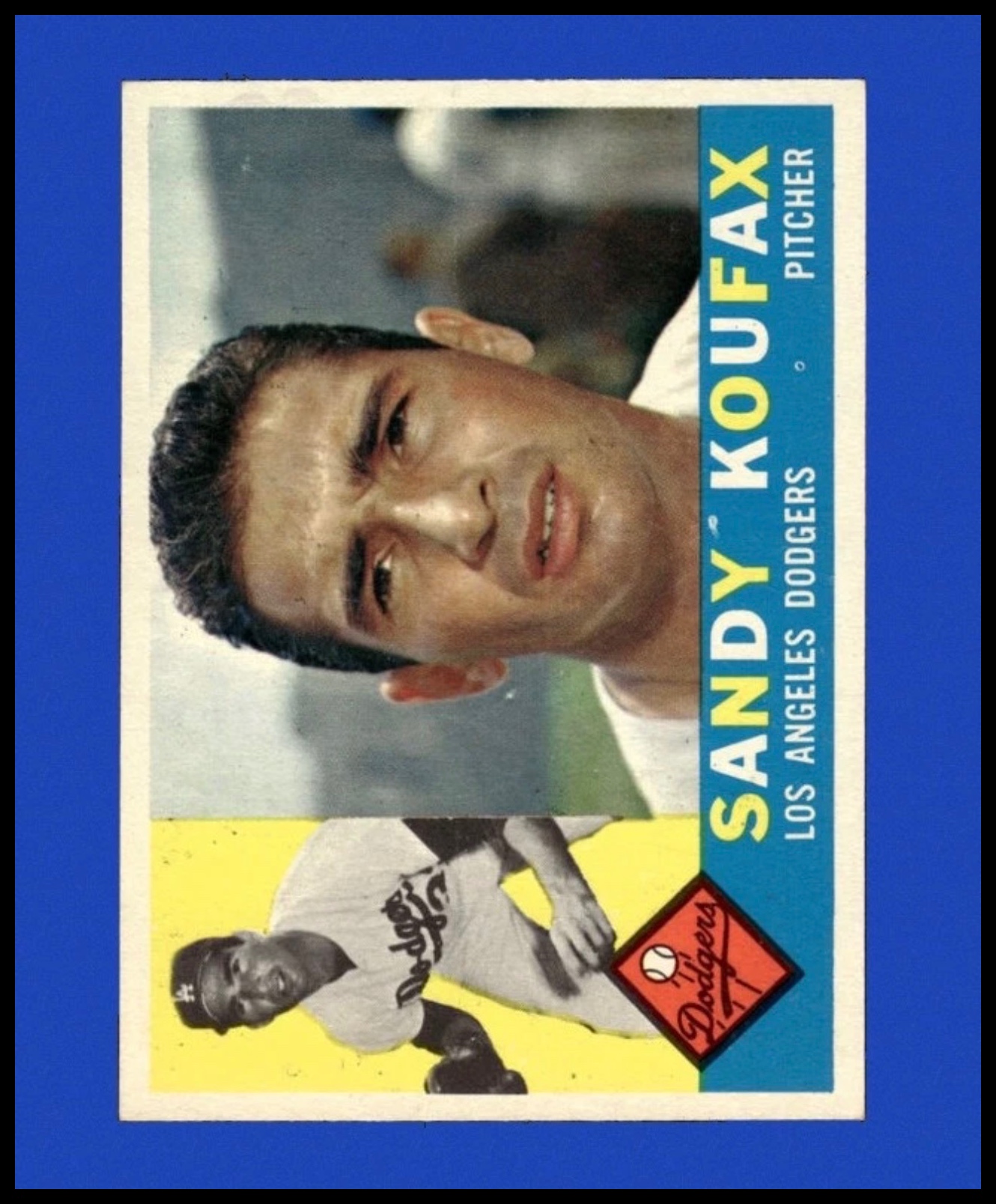
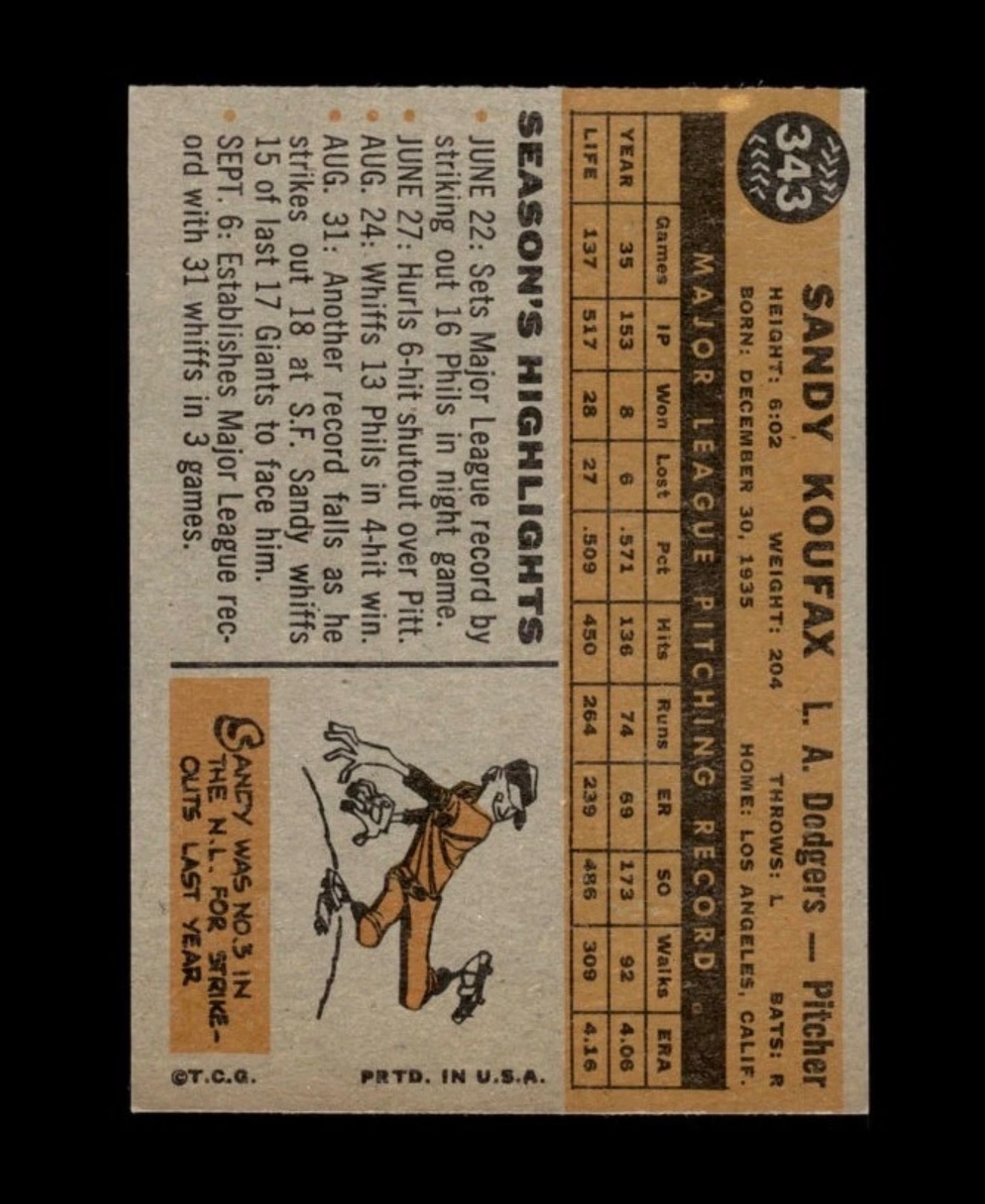
Market outlook
Stable Outlook 7/10
Vintage Hall of Famers like Koufax usually show steady long-term demand, while short-term movement is mostly driven by grading scarcity, auction timing, and overall vintage baseball market conditions. Recent price tracking suggests normal market fluctuation rather than a sharp breakout.[2]
Next months. Likely to remain range-bound with modest fluctuations, especially in graded 6 to graded 8 grades.
Long term. Likely gradual appreciation over 1-3 years, with the strongest gains expected in well-centered, high-grade copies.
History
Sandy Koufax (Sanford Braun Koufax) was a left-handed pitcher for the Brooklyn/Los Angeles Dodgers and became one of the most dominant pitchers in baseball history. By 1963, the year associated with this card request, he had already established himself as a superstar: graded notes that in 1963 he won his first of three pitching Triple Crowns, going 25-5 with 306 strikeouts, a 1.88 ERA, and 11 shutouts. He was known for his exceptional fastball, devastating curveball, and historically great peak performance, including being the first pitcher to throw four no-hitters and one perfect game, and a multi-time Cy Young winner.[1]
This card was first released in the 1963 Topps Baseball set, produced by Topps and issued in wax packs and hobby distribution in the United States in 1963. The specific card number provided, #343, corresponds to the 1963 Topps Sandy Koufax issue.
- Koufax was one of the defining pitchers of the 1960s and is widely regarded as an all-time great.[1]
- The 1963 season was one of his peak years, featuring a 25-5 record, 306 strikeouts, a 1.88 ERA, and 11 shutouts.[1]
- His career totals include 165 wins, 87 losses, 2,396 strikeouts, and a 2.76 ERA.[1]
Rarity and print run
- Tier
- Common
- Print run
- High
- First printed in
- 1963 Topps Baseball
- Demand
- High
- Supply
- Medium
- It is a standard base-card issue rather than a short print or parallel.
- Population scarcity is driven more by grade scarcity than by original pack scarcity.
- High-grade examples are harder to find because 1963 Topps cards are sensitive to centering and corner wear.
Collector notes
Condition. Check centering carefully, as 1960s Topps cards often suffer from off-center cuts. Common flaws include corner wear, edge chipping, surface print defects, gum or wax staining, and color fading. Because this is a star card, eye appeal matters heavily and even small defects can materially reduce value.
Storage. Store in a penny sleeve and rigid top loader or card saver, then place in a cool, dry environment with stable temperature and low humidity. Avoid direct sunlight, PVC-containing holders, and repeated handling. For higher-grade copies, consider professional grading and sealed storage.
Authenticity. Verify print quality, paper stock, aging consistency, and correct card stock thickness. Authentic 1963 Topps cards should show period-correct offset printing characteristics rather than modern digital sharpness. Reprints often have overly crisp images, incorrect gloss, or paper that feels too new. Compare font placement, borders, and back printing against known authentic examples before purchase.
Sources: psacard.com, sportscardinvestor.com, throwbacksportscards.com, sportscardspro.com, deanscards.com