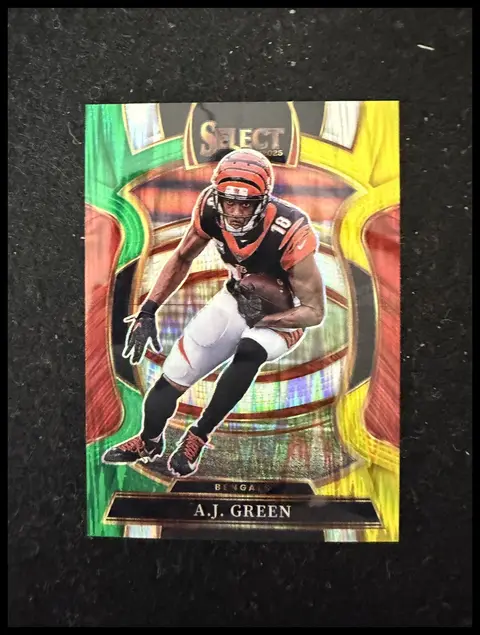
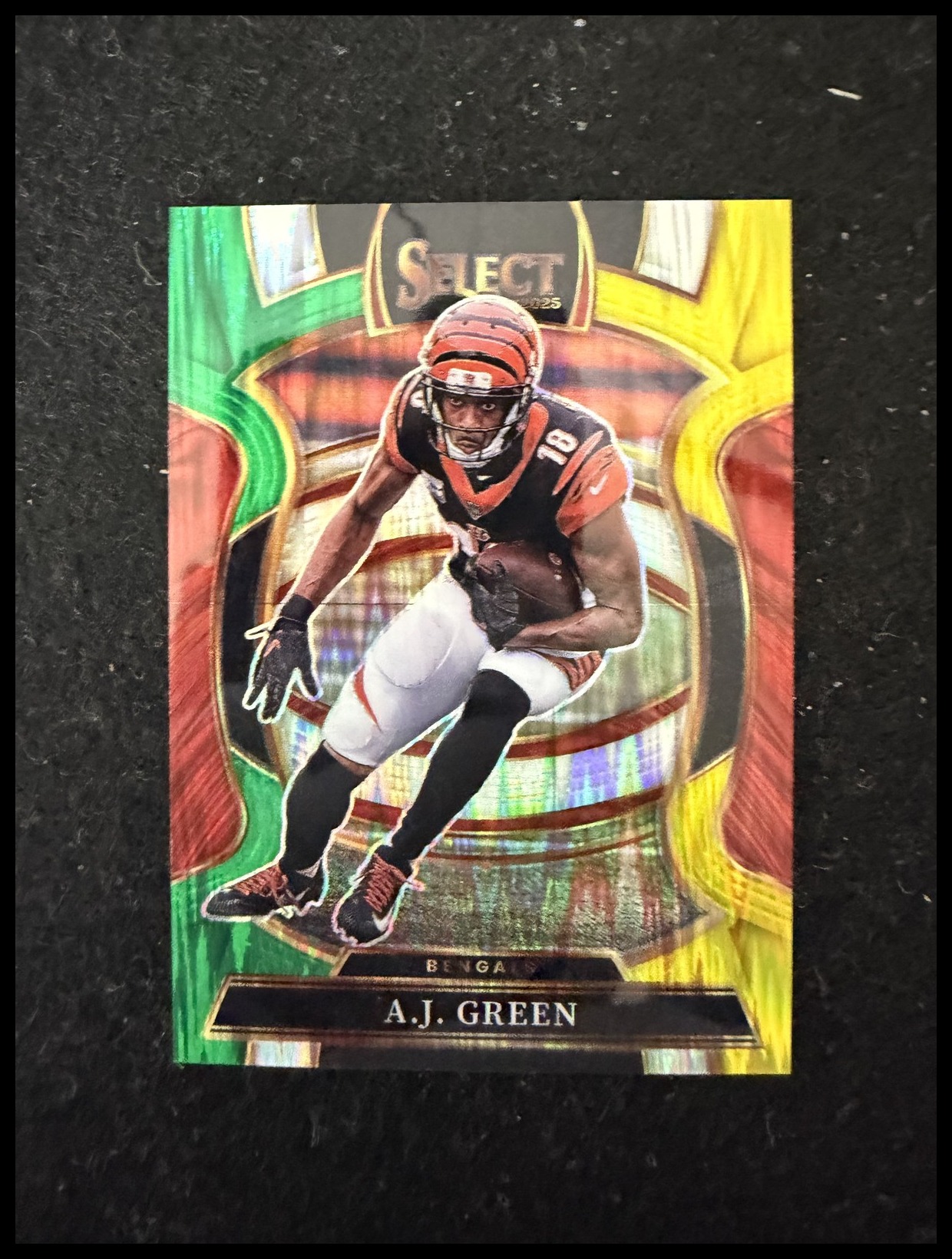
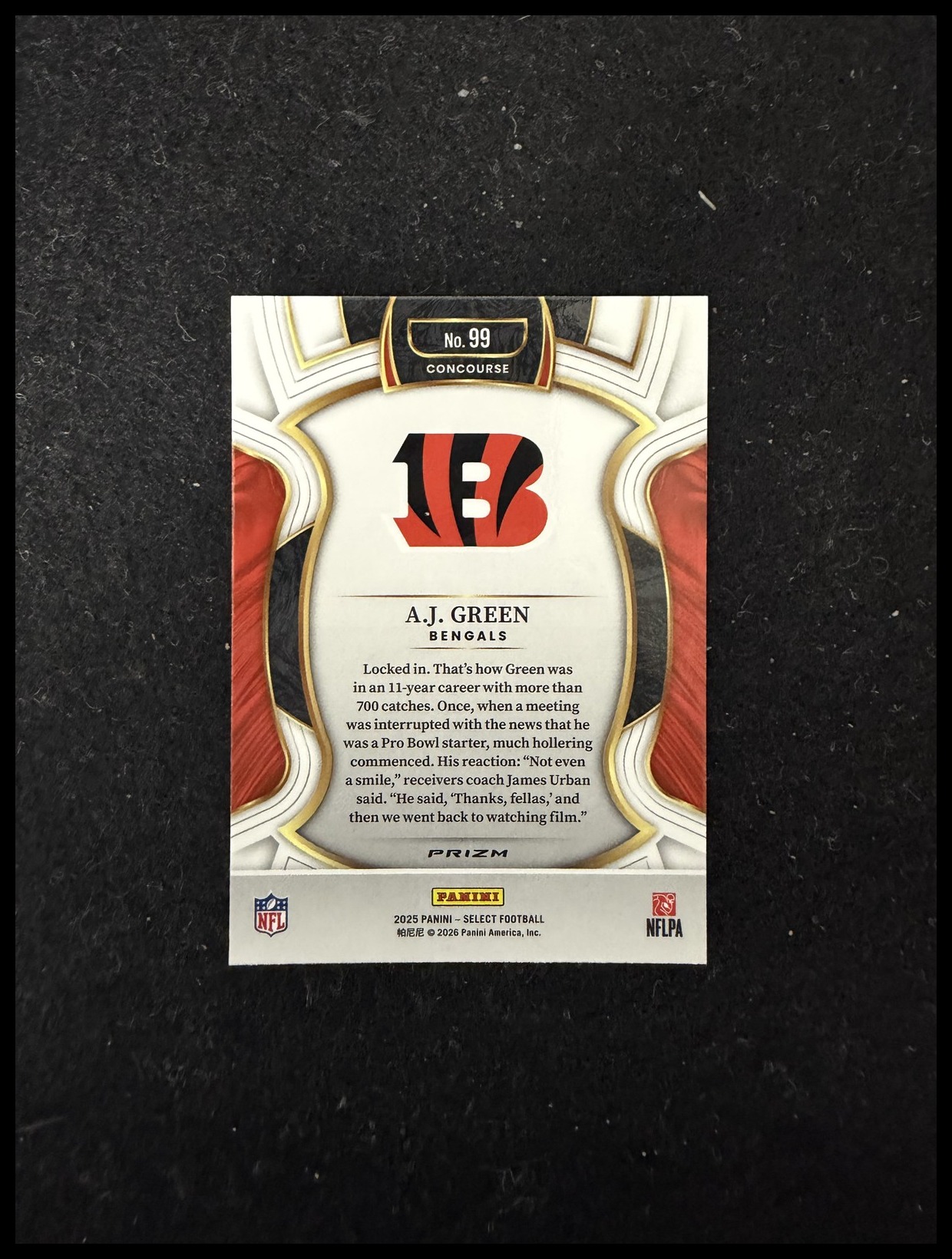
Market outlook
Stable Outlook 7/10
Market remains stable due to consistent collector interest in his legacy and recent media presence, but lack of new prime production and moderate nostalgia limit upward momentum.
Next months. Next 3-6 months: Prices likely to remain stable with minor fluctuations around $50-$300 for graded copies.
Long term. 1-3 year: Potential for modest appreciation if demand increases due to deeper legacy recognition or new media exposure, but not expected to surge dramatically.
History
A.J. Green is a former Cincinnati Bengals wide receiver born on July 31, 1988, in Summerville, SC. He played college football at Georgia and was drafted in the 1st round (4th overall pick) of the 2011 NFL Draft by the Bengals. He is known for his incredible basketball-like plays, including a famous moment where he was oblivious to game pressure while making a crucial play. He later became a coach and was hired as a football-minded coach.
A.J. Green's first football trading card was released in 2011 as a rookie card, notably in sets like 2011 Topps Chrome #150.
- Drafted 4th overall in 2011 NFL Draft by the Cincinnati Bengals
- Played college football at Georgia University
- Renowned for making basketball-like plays and being oblivious to game pressure during crucial moments
Rarity and print run
- Tier
- Rare
- Print run
- High
- First printed in
- 2011 Topps Chrome
- Demand
- Medium
- Supply
- Medium
- Limited production runs for premium subsets like 2025 Panini Prizm Black and 2022 Spectra
- Autographed cards numbered to 99 or 1/1 have extreme scarcity
- Rookie cards from 2011 are more common but still valuable
Collector notes
Condition. Check for centering, corner wear, edge scratches, and surface gloss. Common flaws include micro-bending on the edges and silvering on the border. For chromed cards, verify no tarnishing occurs.
Storage. Store in acid-free sleeves within a rigid top-loader or magnetic case. Keep in a cool, dry environment away from direct sunlight. Use a humidity-controlled box for long-term storage.
Authenticity. Authentic cards have sharp printing with consistent color gradients. Fakes often show blurred text, inconsistent holograms, or lower-quality card stock. For autographed cards, verify the signature's ink flow and compare with known authentic examples. Use professional authentication services like graded or Beckett for verification.
Sources: espn.com, sportscardinvestor.com, sportscardspro.com, sportsmemorabilia.com, gocards.com