Market outlook
Stable Outlook 7/10
Demand should remain steady because Bo Jackson is a perennial name in football card collecting, but abundant supply caps sharp appreciation for raw copies. Graded high-end copies should continue to outperform lower grades.
Next months. Raw and mid-grade prices should remain steady with modest fluctuations; gem-mint copies may continue to command premium prices.
Long term. Over 1-3 years, the card should hold or slowly gain value in high grade, while common raw copies likely stay broadly stable with limited upside.
History
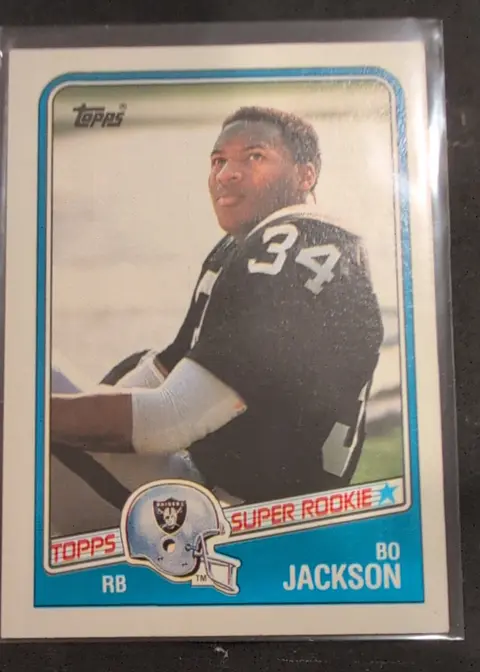
Bo Jackson is a two-sport American athlete whose fame spans professional football and baseball. In football, he became a cultural icon as a rare elite running back for the Los Angeles Raiders, known for extraordinary power, speed, and highlight-reel plays. His 1988 Topps card is significant because it captures the early peak of his NFL fame and is widely treated as his flagship rookie card in the 1988 Topps Football set.
First released in 1988 as part of the Topps Football base set, card #327 featuring Bo Jackson and the Los Angeles Raiders. The card was distributed in standard Topps 1988 football wax packs, rack packs, and boxes through the normal 1988 hobby and retail release.
- Card #327 is widely recognized as Bo Jackson’s Topps rookie card in football.
- The card is commonly labeled or indexed as "Super Rookie" in the market.
- Bo Jackson remains one of the most collected multi-sport athletes, which helps sustain demand for this card despite its common-set status.
Collector notes
Condition. Check centering, corner wear, edge chipping, and surface print defects. The card is from a mass-produced 1980s set, so sharp corners, clean surfaces, and strong centering drive value. Common flaws include off-centering, whitening on corners, print dots, wax/stain marks, and small surface scratches.
Storage. Store in a penny sleeve and semi-rigid holder or top loader, then keep in a cool, dry environment away from direct sunlight. For higher-grade copies, use an archival sleeve and avoid repeated handling to preserve corners and gloss.
Authenticity. Authentic cards should match the standard 1988 Topps stock, size, typography, and back design. Watch for overly glossy reprints, blurry text, incorrect card stock, and altered corners or trim. For higher-value copies, grading-service authentication is the safest route.