Market outlook
Stable Outlook 4/10
The base card is common and widely available, which limits long-term appreciation. However, Nolan Ryan remains a blue-chip Hall of Fame name, and top-graded copies can hold value better than typical commons due to collector recognition and registry demand.
Next months. Likely to remain stable with modest fluctuations based on grading-market activity and auction timing.
Long term. Expect slow, selective appreciation for high-grade copies, while raw and mid-grade examples should remain inexpensive and plentiful.
History
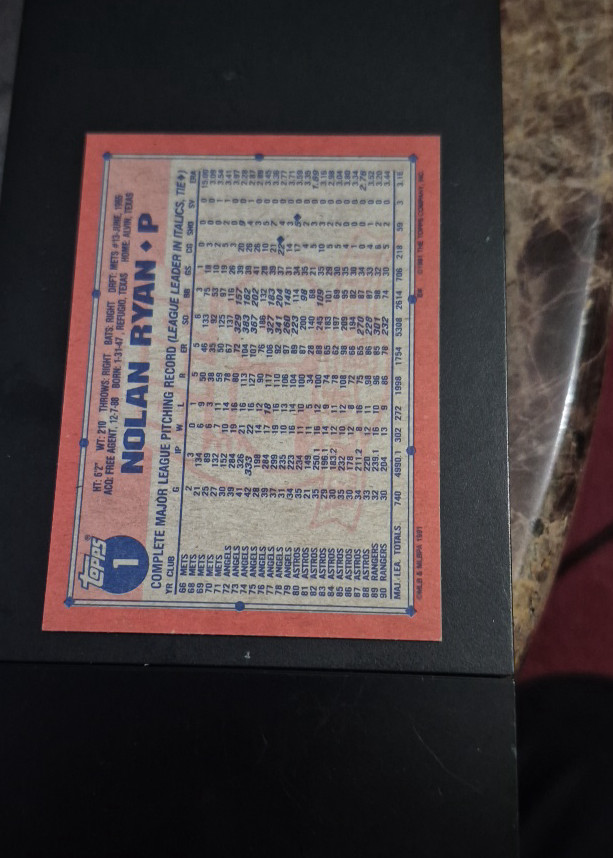
Nolan Ryan is one of the most iconic pitchers in baseball history, known for his overpowering fastball, longevity, and record-setting strikeout totals. Born in 1947 in Alvin, Texas, he played for the Mets, Angels, Astros, and Rangers, and became a Hall of Famer in 1999. The 1991 Topps card captures Ryan late in his career and is significant as a mainstream base issue of one of the most collectible players in the hobby.
First released in 1991 as part of Topps Baseball Series 1, distributed in the United States through hobby shops, wax packs, and retail outlets. Card #1 in the set, featuring Nolan Ryan, is one of the flagship cards from the 1991 Topps Baseball release.
- Card #1 in the 1991 Topps Baseball set, giving it added set-opening visibility and collector interest.
- Nolan Ryan is one of the most collected pitchers of all time, which helps sustain demand despite the card being a common-era base card.
- The 1991 Topps issue also has recognized premium-related parallels/variants in the broader product family, including Desert Shield versions that are far scarcer than the base card.
Rarity and print run
- Tier
- Common
- Print run
- Very High
- First printed in
- 1991 Topps Baseball
- Demand
- Medium
- Supply
- High
- Base card from a mass-produced flagship set
- Extremely high original print volume
- Widely available in raw condition
- High-grade copies are less common than raw supply suggests because centering and corner quality are often imperfect
Collector notes
Condition. This is a mass-produced common-era card, so condition is crucial. Check centering, sharp corners, surface gloss, print snow, roller marks, edge wear, and chipping. White borders can hide some wear, but focus on corner softness and back-side staining. graded 9 and graded 10 examples are notably tougher to find clean than raw copies suggest.
Storage. Store in penny sleeves and rigid top loaders or semi-rigid holders. Keep away from humidity, heat, and direct sunlight to prevent warping and surface dulling. For higher-grade copies, consider sealed graded holders and archival storage boxes with low-humidity control.
Authenticity. Base 1991 Topps cards are easy to authenticate by comparing print quality, stock, finish, and dimensions to known genuine examples. Look for modern reprint gloss differences, blurry text, incorrect stock thickness, or off-color printing. Because the card is common, most authenticity issues involve reprints or altered copies rather than sophisticated counterfeits.
Sources: sportscardspro.com, sportsmemorabilia.com, sportscardinvestor.com, psacard.com, youtube.com