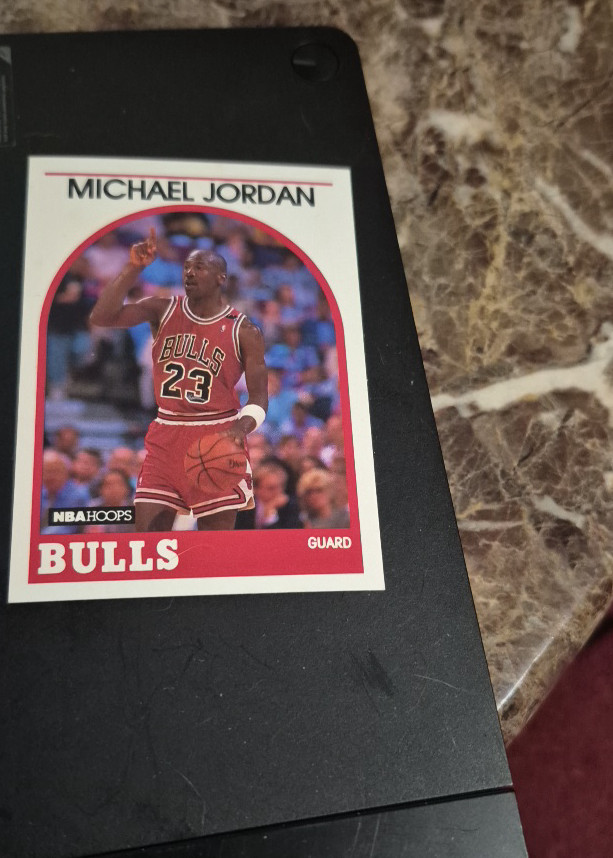
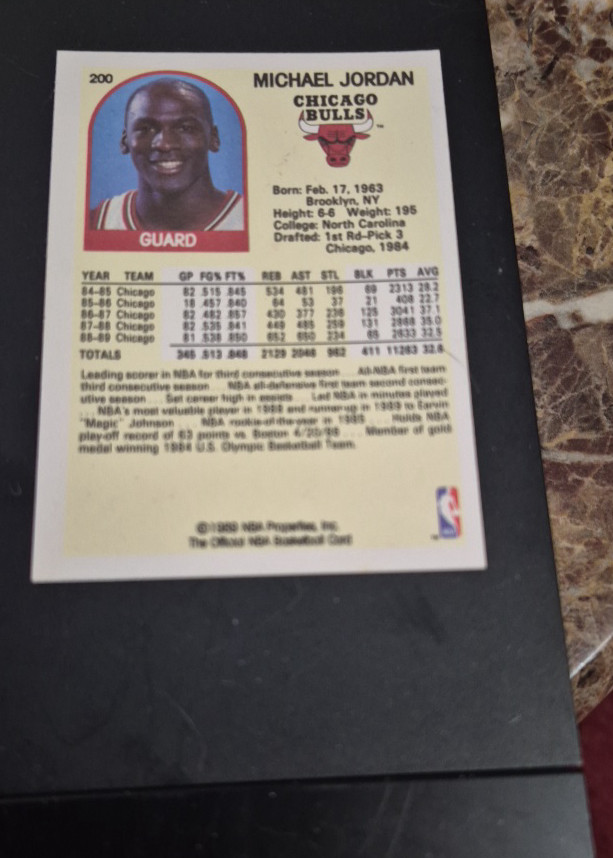
Market outlook
Stable Outlook 6/10
The card benefits from enduring Michael Jordan demand, but its very high print run limits broad appreciation outside gem-mint examples. Prices for raw and lower-grade copies typically move with overall basketball card market sentiment rather than scarcity shock.[1][2]
Next months. Likely to remain range-bound with modest fluctuations, especially for raw and mid-grade copies.
Long term. Gradual appreciation is possible in higher grades, but most value growth should remain concentrated in graded 9 and graded 10 examples rather than common raw copies.
History
Michael Jordan is widely regarded as the most iconic basketball player of the modern era, a six-time NBA champion, five-time MVP, and global sports figure whose popularity helped drive the basketball card boom of the late 1980s and early 1990s. His 1989 Hoops #200 card is historically significant because it is commonly treated as his first mainstream NBA Hoops base card and one of the defining cards of the early mass-produced modern basketball era.[1][4]
First released in the 1989-90 NBA Hoops basketball set, distributed in 1989 as part of the set’s original retail issue.[1][4]
- This card is widely described in price guides as Michael Jordan’s first NBA Hoops card.[1]
- It comes from the flagship 1989 Hoops set, one of the earliest widely collected modern basketball card releases.[1][4]
- graded maintains a dedicated spec entry for Michael Jordan #200 in the 1989 Hoops set, confirming its cataloged status as a standard base card.[4]
Collector notes
Condition. The card is usually found raw and was mass-produced, so centering, corner whitening, edge chipping, and surface wear are the key condition checks. Because it was heavily handled and stored in commons boxes, print defects, roller marks, and soft corners are common, and sharp graded 9/10 copies are much harder to find than raw copies.[1][2]
Storage. Store the card in a penny sleeve and rigid top loader or card saver, keep it away from moisture and direct sunlight, and avoid over-handling to preserve corners and edges. For higher-grade copies, submit or store in a semi-rigid holder and keep in a stable temperature and humidity environment.
Authenticity. Authentic cards should match the standard 1989 Hoops base design, stock, and print quality associated with the set. Because the card is common and widely available, fake risk is generally lower than with ultra-rare vintage cards, but buyers should still inspect print texture, alignment, and surface gloss, and compare against graded reference images/specs when possible.[4]