Market outlook
Stable Outlook 7/10
The card already trades as a premium chase piece, so near-term movement is usually driven by grading population, sealed supply opening, and broader One Piece collector demand rather than by in-set scarcity alone. High-end manga alternate art cards often stabilize after initial hype, then trend gradually with character popularity and overall market health.
Next months. Expect relatively stable prices with periodic spikes when high-grade sales appear or sealed OP14 supply tightens.
Long term. Over 1-3 years, the card should remain a strong collector piece with moderate appreciation potential, especially in top grades, assuming One Piece demand remains healthy.
History
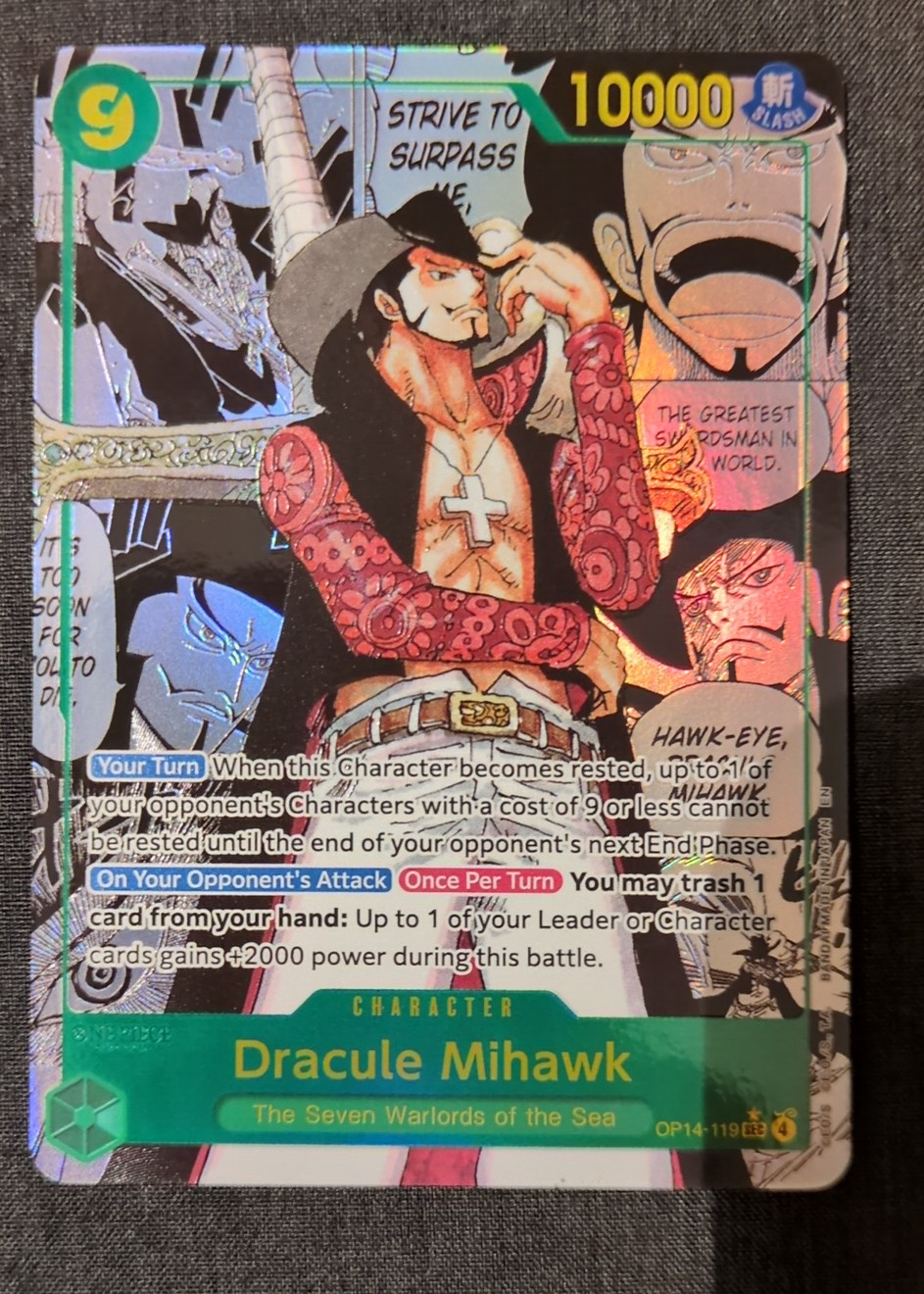
Dracule Mihawk is one of the most important swordsmen in One Piece, known as the "Strongest Swordsman in the World" and a former Shichibukai (Warlord of the Sea). He serves as a benchmark of swordsmanship in the series and is a major figure in Zoro's backstory and long-term goal. In the One Piece Card Game, Mihawk is a premium character subject to collector demand because of his popularity, villain prestige, and recurring presence across high-end rarities.
This card was first released in Japan in the One Piece Card Game set "The Azure Sea's Seven" (OP14), with a listed release date of January 16, 2025. The specific card number is OP14-119, and the variant referenced here is the Japanese Manga Alternate Art Secret Rare version.
- OP14-119 is a Secret Rare card and also exists as an Alternate Art version, making it one of the chase cards from its set.
- Price tracking sources list the base OP14-119 and the alternate art version separately, indicating distinct collectible variants and market values.
- A graded 10 Japanese manga alternate art copy has been publicly listed with a lowest price of $2,940, showing substantial premium demand for high-grade copies.
Rarity and print run
- Tier
- Secret Rare
- Print run
- Low
- First printed in
- The Azure Sea's Seven (OP14)
- Demand
- High
- Supply
- Scarce
- Secret Rare classification
- Manga Alternate Art treatment
- Japanese-language premium chase status
- High grade scarcity due to centering and surface sensitivity
Collector notes
Condition. Check for edge whitening, corner dings, centering, surface scratches, and print lines, especially on the foil and manga-style alternate art surface. Japanese high-end One Piece cards are sensitive to factory whitening on edges and subtle surface scuffs that can reduce graded value significantly. Because this is a premium secret/alt-art card, even minor flaws can materially affect graded/graded/graded grade outcomes.
Storage. Store the card immediately in a perfect-fit sleeve and rigid top loader or semi-rigid holder, then keep it in a dry, cool, UV-protected environment. For long-term preservation, use archival-grade sleeves and avoid repeated handling without gloves or clean hands. If submitting for grading, keep the card sleeved and minimize friction from repeated card transfers.
Authenticity. Verify the card number OP14-119, the Japanese text layout, holographic finish, and the correct manga alternate-art artwork. Authentic One Piece Japanese cards should have clean print registration and consistent foil stamping; counterfeit cards often show dull foil, blurry text, incorrect saturation, or off-color borders. Compare weight, cardstock feel, and the back printing against a verified authentic Japanese One Piece card from the same era.
Sources: pricecharting.com, alt.xyz, tcgplayer.com, youtube.com, collectorstore.com