Market outlook
Rising Outlook 8/10
The 1966 Topps set is increasingly recognized as underrated, and Mays as the #1 card is a prime target for collectors. High-grade copies are scarce, and demand from both vintage and modern collectors is strong, driving prices upward[2][7].
Next months. Next 3-6 months: Prices for graded 8 and 9 copies are expected to remain stable or rise slightly due to consistent demand and limited supply[3].
Long term. 1-3 years: Continued appreciation is likely as the 1966 Topps set gains more collector attention and high-grade Mays #1 cards become increasingly scarce, potentially pushing graded 9 prices above $50,000[2][3].
History
Willie Mays was one of the greatest baseball players of all time, known for his exceptional all-around skills including hitting, power, speed, and defense. He played primarily for the San Francisco Giants and New York Yankees, winning 12 Gold Gloves and 4 MVP awards. He was elected to the National Baseball Hall of Fame in 1979 and is widely considered the premier center fielder in baseball history[2].
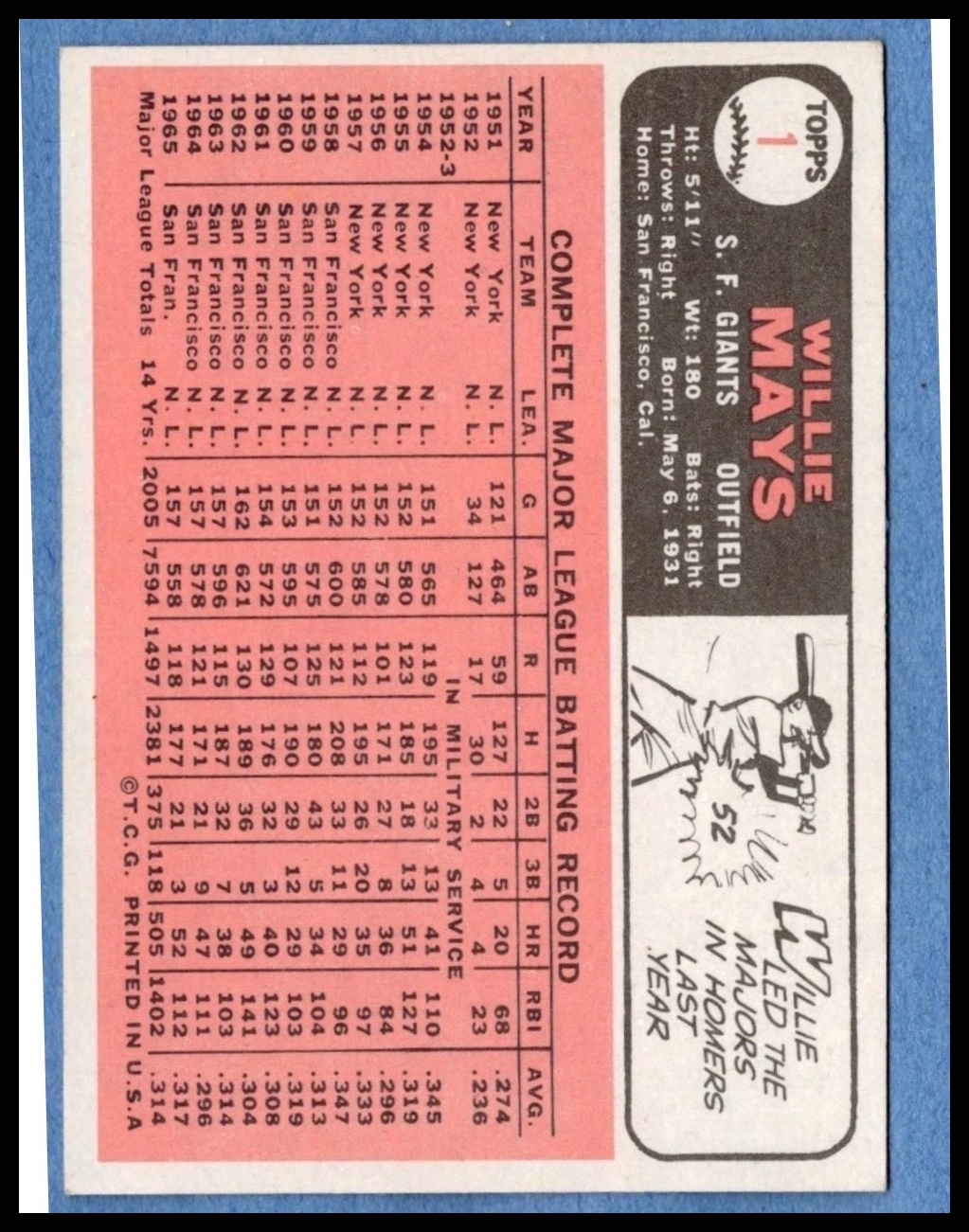
This card was first released in 1966 by Topps as the very first card (#1) in the 1966 Topps Baseball set. The set launches with Willie Mays, making his #1 card a key and highly sought issue from the beginning[2][8].
- Willie Mays is the #1 card in the 1966 Topps set, making it the marquee card of the set[8].
- Being the #1 card makes finding Willie Mays in top condition even more difficult than other cards in the set[8].
- The 1966 Topps set is considered one of the most underrated issues in baseball card history, with Mays as a key card[2][7].
Rarity and print run
- Tier
- Rare
- Print run
- High
- First printed in
- 1966 Topps Baseball
- Demand
- Very High
- Supply
- Low
- Being the #1 card in the set makes high-grade copies extremely difficult to find due to handling and demand[8].
- 1966 Topps cards are often off-center and have wear, reducing the population of high-grade copies[2].
- Mays' legendary status and Hall of Fame recognition (1979) drive sustained collector interest, increasing scarcity of top-tier copies[2].
Collector notes
Condition. Key flaws to check include centering (1966 Topps cards are often off-center), corner wear, and edge wear. The #1 card is especially difficult to find in high grades due to its prominence and handling. Look for surface scratches, print spots, and any creases. Mays' uniform and face details should be sharp with no blurring[2][8].
Storage. Store the card in a hard plastic protector (toploader) or a sealed mylar sleeve, kept in a climate-controlled environment away from light, heat, and humidity. Use a card box or storage case to prevent bending or pressure damage. Avoid handling the card directly to prevent oil transfer and wear[2].
Authenticity. Fakes or reprints can be identified by examining print quality, color saturation, and paper stock. Authentic 1966 Topps cards have a specific gloss and weight. Look for the correct Topps logo font and placement. Reprints may have overly sharp details or different paper textures. Authentication by graded, graded, or Beckett is recommended for high-value copies[2].
Sources: psacard.com, sportscardinvestor.com, sportscardspro.com, deanscards.com, baseball-almanac.com