Market outlook
Stable Outlook 7/10
The card has steady rookie-card demand because Maxey remains a highly relevant player, but the massive print run keeps the base version from behaving like a scarce asset. Prices typically move with player performance, playoff exposure, and grading population shifts rather than scarcity alone.
Next months. Likely to remain in a narrow, mostly stable range, with modest spikes if Maxey has a hot playoff run or major accolade.
Long term. Over 1-3 years, gradual appreciation is possible if Maxey becomes a sustained All-Star-level centerpiece; otherwise the base card should remain a low-priced, liquid rookie with limited scarcity-driven upside.
History
Tyrese Maxey is an American professional basketball player from Garland, Texas, best known for his explosiveness, scoring versatility, and rapid development into a high-level NBA guard. After starring at the University of Kentucky, he was selected 21st overall in the 2020 NBA Draft by the Philadelphia 76ers. His importance to collectors rose sharply as he became a core piece for a major-market contender and developed into one of the league’s more exciting young guards, with strong fan appeal, speed-based highlights, and All-Star caliber upside.
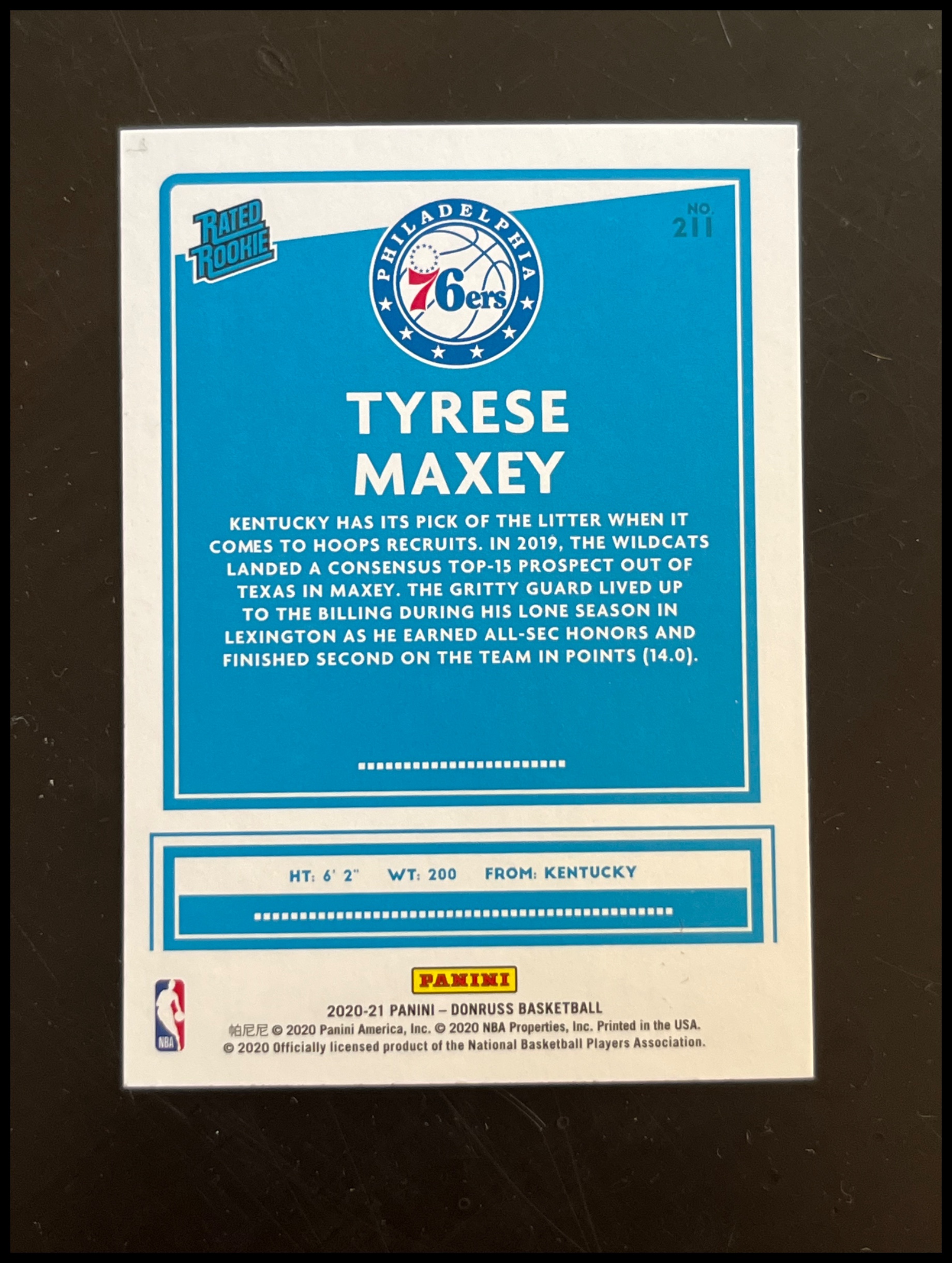
This card was first released in the 2020-21 Panini Donruss Basketball product, initially distributed in hobby and retail formats through the 2020-21 release cycle. It appears as card #211 in the Rated Rookie subset, with broad U.S. hobby shop, online retailer, and retail pack distribution.
- Card #211 is Tyrese Maxey’s base Rated Rookie card in 2020-21 Donruss Basketball.
- This is one of Maxey’s earliest mainstream rookie cards and is widely collected as a key entry-point RC.
- The Donruss Rated Rookie design is a long-running flagship-style rookie branding that remains highly recognizable to basketball card collectors.
Rarity and print run
- Tier
- Common
- Print run
- Very High
- First printed in
- 2020-21 Panini Donruss Basketball
- Demand
- High
- Supply
- Abundant
- Mass-produced base rookie from a widely opened retail/hobby product
- Not serial-numbered
- No special stamping or short-print designation
- High surviving population in raw and graded form
Collector notes
Condition. Check centering carefully, especially front borders and the player image alignment. Common flaws include soft corners, edge chipping on dark borders, surface scratches, print lines, dimples, and roller marks. Rookie cards from Donruss can also show minor factory whitening along edges and corners, so graded 9/10 examples need clean surfaces and strong centering.
Storage. Store in penny sleeves and rigid top loaders or card savers for raw copies, and consider grading only crisp, well-centered examples. Keep cards away from humidity, direct sunlight, heat, and pressure. For graded copies, use slab sleeves and organize vertically to avoid abrasion.
Authenticity. Counterfeits are less common for a mass-produced base card than for serial-numbered parallels or autographs, but buyers should still verify the correct card number (#211), set branding, font quality, sharp image printing, and authentic Panini stock. Compare weight, surface gloss, and edges against known genuine copies. For higher-value graded examples, prefer graded/graded/graded encapsulation or buy from trusted sellers with clear scans and return policy.
Sources: sportscardspro.com, sportscardinvestor.com, steelcitycollectibles.com, toywiz.com, storied.tech