Market outlook
Stable Outlook 7/10
The 1964 Topps set remains a cornerstone of vintage baseball collecting. Perry's Hall of Fame status ensures steady demand, but the card's common status in lower grades limits rapid price growth. High-grade copies may see modest appreciation due to scarcity[2][3][4].
Next months. Next 3–6 months: Prices will remain stable with slight increases for high-grade copies (9–10) due to collector interest in vintage sets[3][4].
Long term. 1–3 years: Moderate growth expected for Mint and Gem copies as supply remains limited and demand for iconic vintage sets persists[2][4].
History
Gaylord Perry was a Hall of Fame professional baseball pitcher known for his longevity, competitiveness, and the infamous 'spitball' technique. He debuted with the San Francisco Giants in 1962 and became one of the most dominant pitchers of the 1960s and 1970s, winning two Cy Young Awards and playing for multiple teams including the Giants, Padres, Yankees, and Texas Rangers. He was inducted into the Baseball Hall of Fame in 1991[1][7].
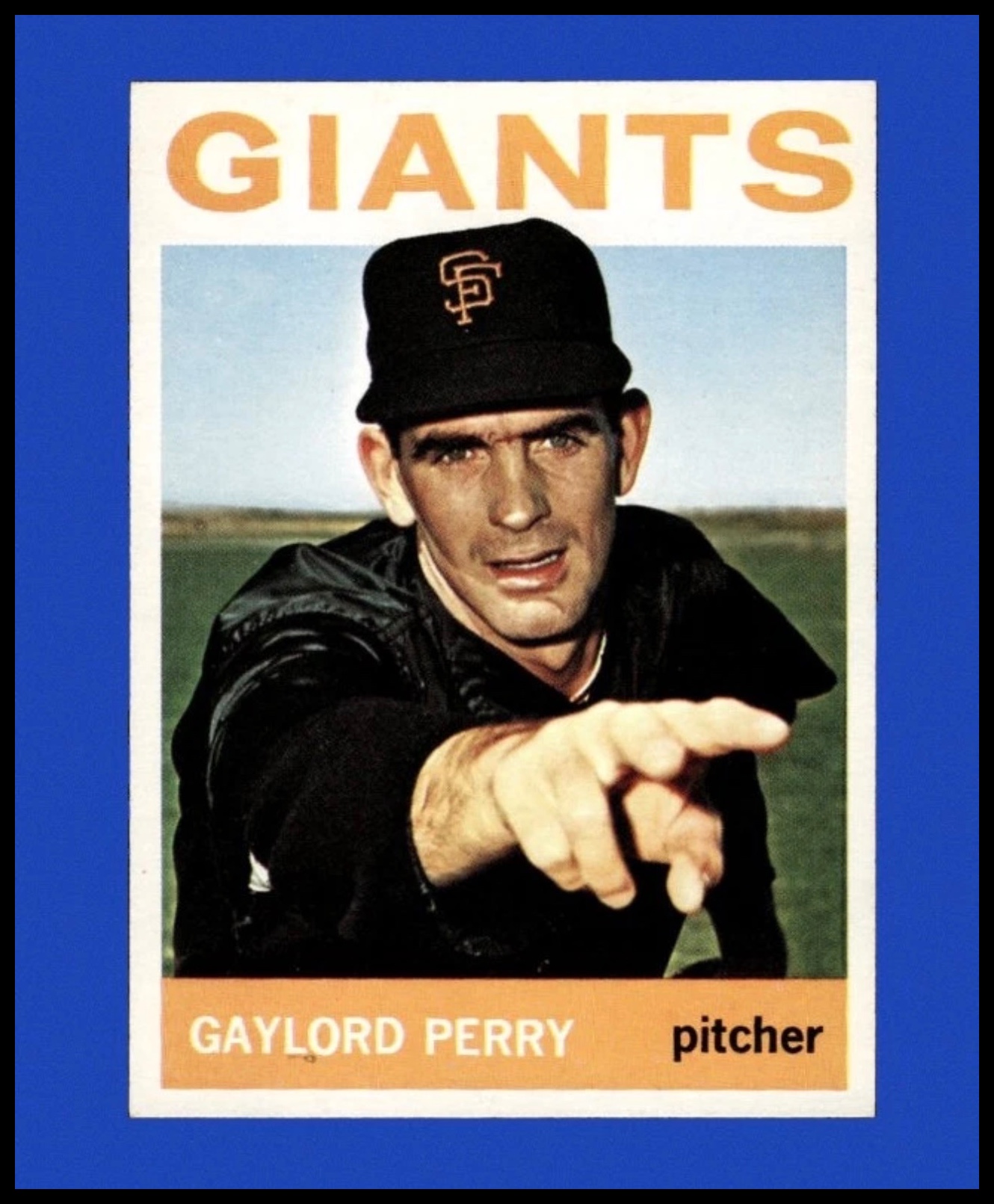
This card was first released in 1964 as part of the Topps Baseball set in the United States. It features Perry during his early career with the San Francisco Giants[1][7].
- Gaylord Perry won two Cy Young Awards (1972 with Giants, 1978 with Padres)[1]
- He is one of the few pitchers to win Cy Young Awards in both leagues[1]
- Perry was known for his 'spitball' technique and was a controversial but highly effective pitcher[1]
Rarity and print run
- Tier
- Common
- Print run
- High
- First printed in
- 1964 Topps Baseball
- Demand
- Medium
- Supply
- Medium
- Released in mass production in 1964, making it common in lower grades
- High-grade copies (Mint 9+, Gem 10) are scarce due to age and fragility of 1964 cardstock
- Perry's Hall of Fame status ensures consistent demand, but not extreme rarity
Collector notes
Condition. Check for centering, edge wear, corner dents, and surface scratches. Common flaws include off-center printing, gum stains from storage, and creases. The cardstock of 1964 Topps is prone to yellowing and softening over time[1][4].
Storage. Store in a rigid plastic holder (toploader) or mylar sleeve, keep in a cool, dry environment away from direct sunlight. Use a card album with UV protection for long-term storage. Avoid folding or bending the card[1][2].
Authenticity. Fakes often have incorrect color saturation, misaligned printing, or modern cardstock. Reprints may lack the original texture or have 'reprinted' text. Authenticate by comparing with known genuine examples and checking for graded or Beckett grading certification[2][4].
Sources: etsy.com, psacard.com, sportscardinvestor.com, sportscardspro.com, collectibles.com