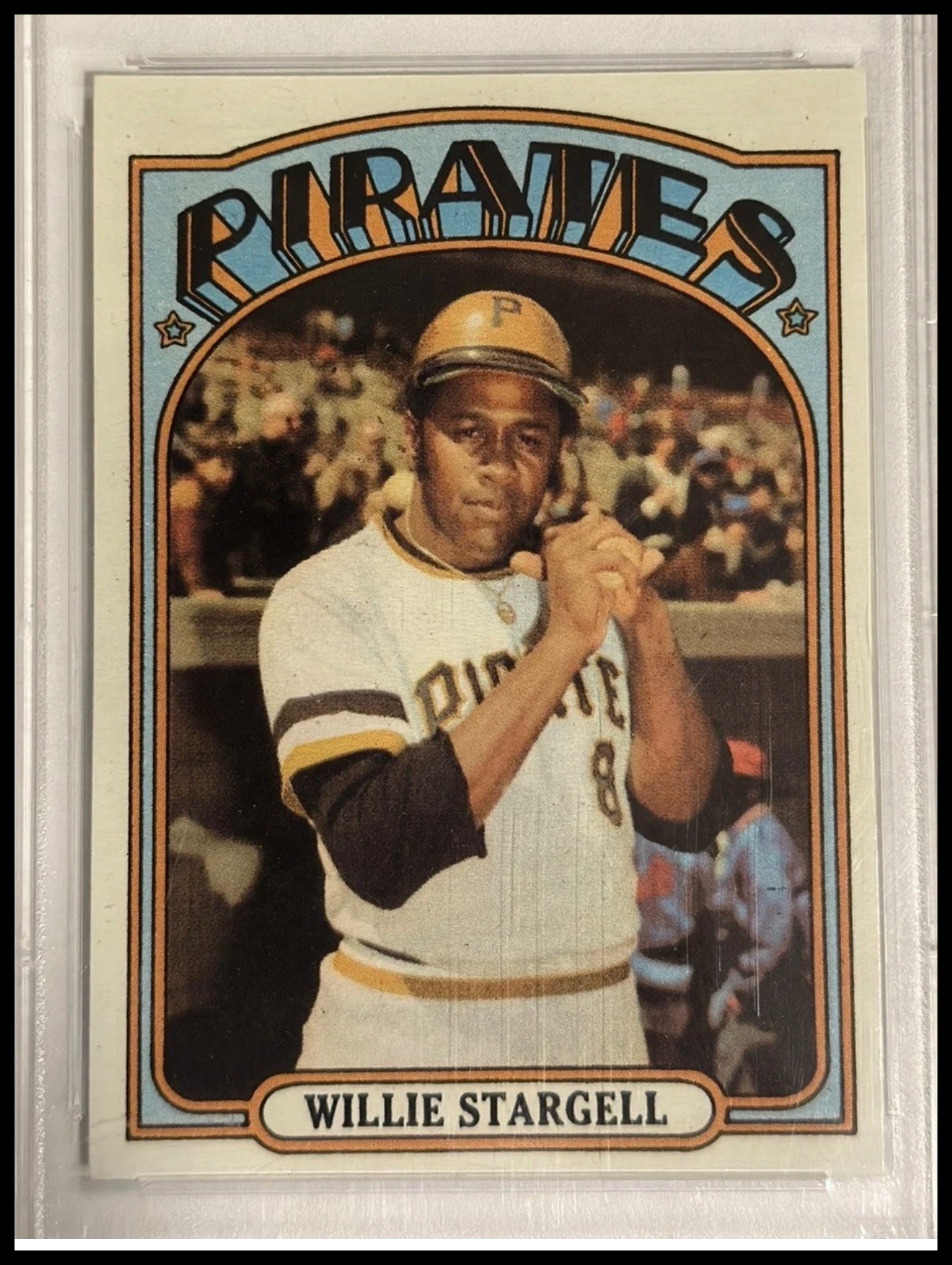
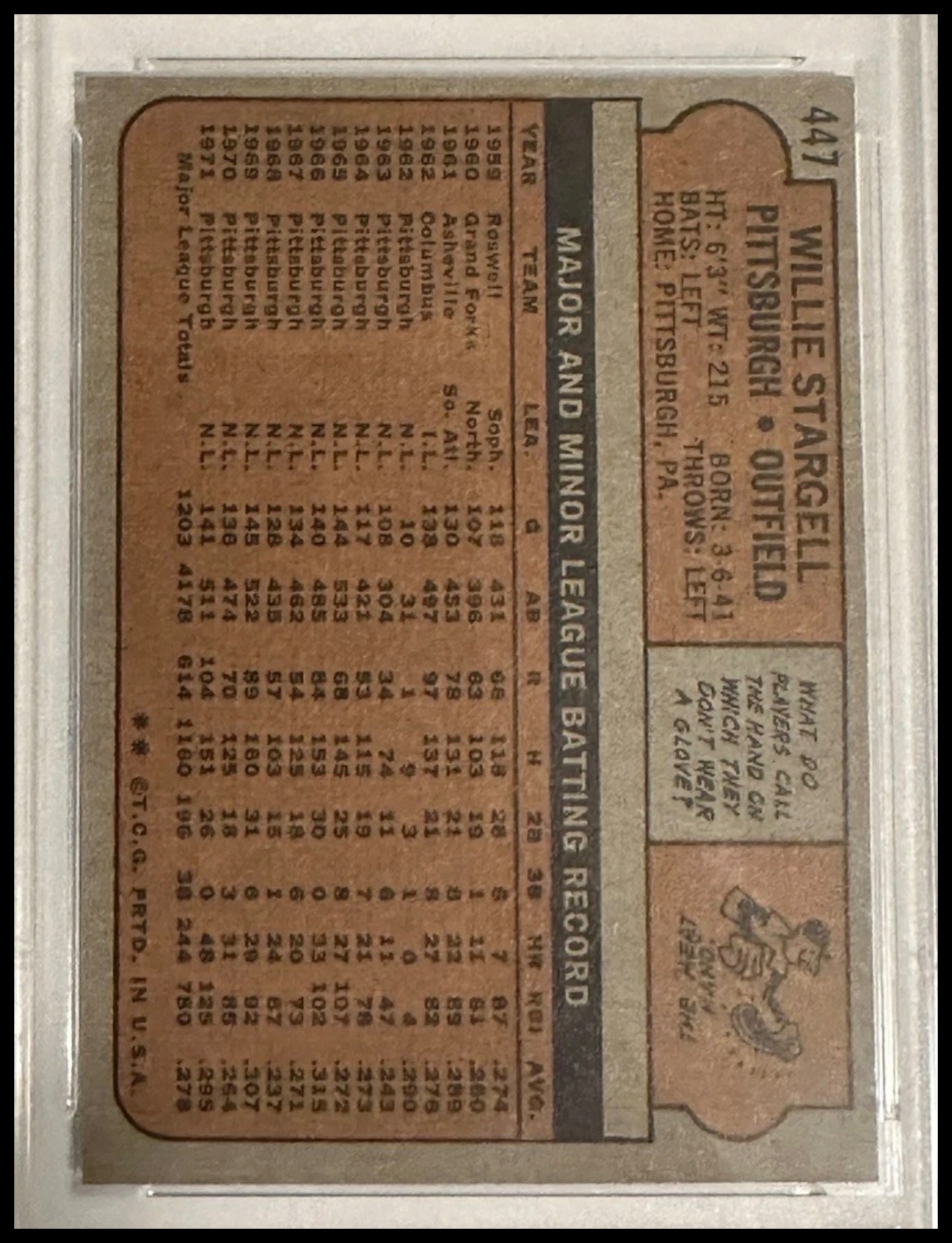
Market outlook
Stable Outlook 6/10
The card is a common issue with high supply, so prices remain stable for raw or low-grade copies. High-grade graded 10 copies may see modest appreciation due to Stargell’s Hall of Fame status and nostalgia for 1970s cards, but not enough to drive a strong upward trend [1][4].
Next months. Prices will remain flat for raw copies; graded 10 may see slight gains if demand for HOF 1970s cards increases.
Long term. Moderate appreciation for graded 10 copies over 1–3 years as vintage 1970s cards become more prized; raw copies unlikely to gain significant value.
History
Willie Stargell was a legendary left-handed power hitter for the Pittsburgh Pirates, nicknamed 'Pops' or 'Stargell the Star.' He played his entire 21-year MLB career (1962–1982) with the Pirates, earning seven All-Star selections, two World Series titles (1971, 1979), and being named the 1979 World Series MVP and NL MVP. He was the first player to hit 300 home runs and 300 doubles for the Pirates and is a member of the 500-home run club, finishing with 475. He was inducted into the Baseball Hall of Fame in 18.
This card was first released in the United States in 1972 as part of the 1972 Topps Baseball set, printed by Topps Chromes in New York [1].
- Stargell wore number 447 on this card but is famously associated with number 8 during his Pirates career.
- This is his second-year Topps card, following his 1971 rookie card (#500), and features him in a standard pitching/striking pose for the Pirates.
- The card is part of a highly collectible 1972 Topps set known for its bright orange borders and iconic design that defined early 1970s baseball card aesthetics.
Rarity and print run
- Tier
- Common
- Print run
- Very High
- First printed in
- 1972 Topps Baseball
- Demand
- Medium
- Supply
- Abundant
- Massively printed in 1972 as a standard issue common card
- graded 10 copies are extremely scarce due to centering and corner wear issues inherent to the printing process
- No special variant or stamp increases rarity; standard English-language print only
Collector notes
Condition. Key flaws include centering issues typical of 1970s Topps cards, corner wear due to thin stock, and edge wear from the orange border. Check for whitening on the back, especially around the corners, and ensure the image is not off-center. graded 10 copies are extremely rare due to these manufacturing variances [1].
Storage. Store in a rigid, non-PVC plastic sleeve (toploader) and keep in a cool, dry environment away from direct sunlight. Use a carbon-free box for long-term storage and avoid handling the card surface directly to prevent oil transfer [2].
Authenticity. Fakes are uncommon for this common card, but reprints may exist. Original 1972 Topps cards have a distinct cardboard texture and slightly off-white back with orange borders. Reprints often have overly sharp images, brighter colors, or different paper stock. Authentication through graded, graded, or graded is recommended for high-value graded copies [1][3].