Market outlook
Rising Outlook 9/10
Sustained appreciation due to Alcindor/Abdul-Jabbar's all-time great status, ultra-low high-grade supply, and no recent graded 10 sales pushing values higher[2][4][5].
Next months. Continued upward pressure on mid-to-high grades with low supply and steady collector demand.
Long term. Strong growth potential as premier 1960s basketball rookie, likely exceeding $1M for graded 10 in future auctions.
History
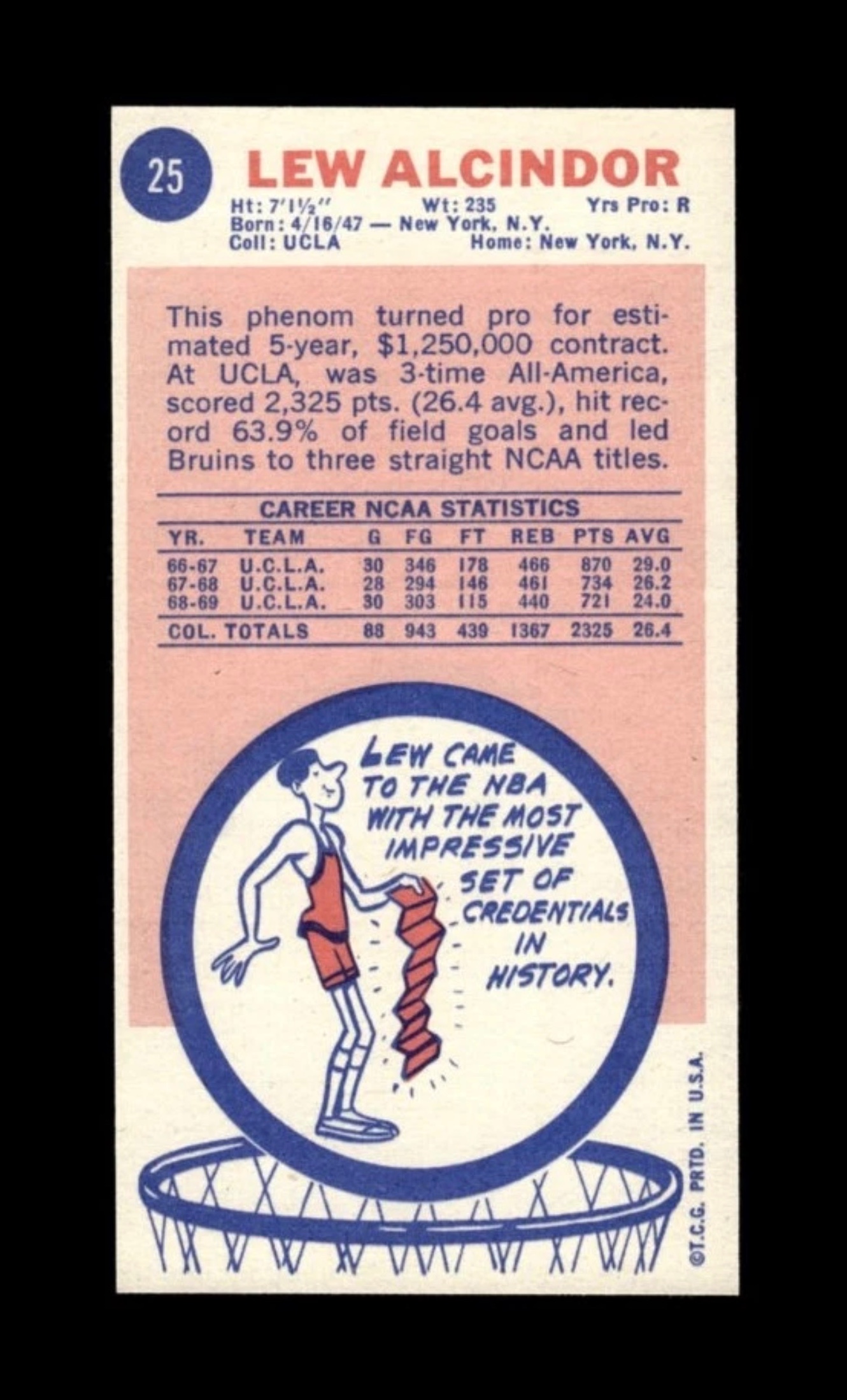
Lew Alcindor, born Ferdinand Lewis Alcindor Jr. on April 16, 1947, later known as Kareem Abdul-Jabbar, was a dominant basketball player who led Power Memorial Academy to a 79-2 record including a 71-game winning streak, guided UCLA to three straight NCAA titles (1967-1969), and was the #1 pick in the 1969 NBA Draft by the Milwaukee Bucks, winning Rookie of the Year, leading the league in scoring and field goals, and eventually securing six NBA championships with the Bucks and Lakers over 20 seasons as a 19-time All-Star and 10-time All-NBA First Team member[1][2].
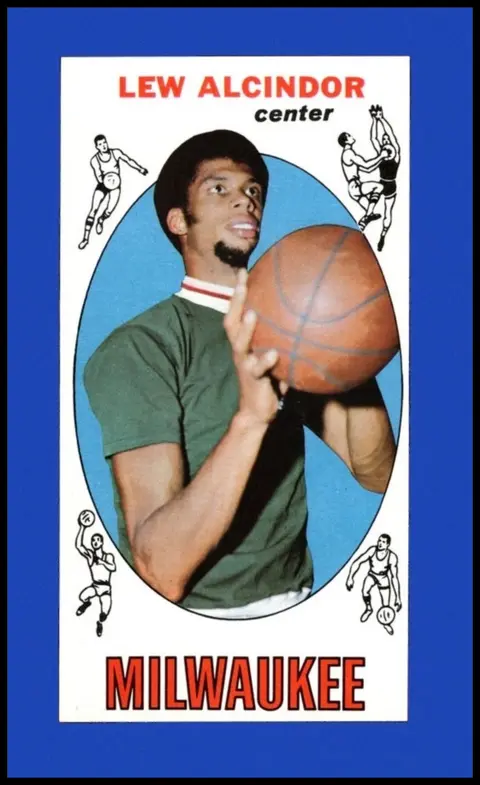
First released in 1969 as part of the Topps Basketball 'Tall Boys' set during Alcindor's rookie season with the Milwaukee Bucks[1][2][3].
- This is Alcindor's only official NBA rookie card and the key card of the 1969 Topps set featuring 99 oversized cards with 32 Hall of Famers[1][2][3].
- Cards were sold in 10-card packs including a 10-inch fold-out ruler featuring one of 24 players, including Alcindor[3].
- Alcindor changed his name to Kareem Abdul-Jabbar after this card's release but it remains his recognized rookie[1][2].
Rarity and print run
- Tier
- Ultra Rare
- Print run
- Medium
- First printed in
- 1969 Topps Basketball (Tall Boys)
- Demand
- Very High
- Supply
- Scarce
- Oversized 'Tall Boys' format leads to higher wear and lower survival in high grades[1].
- Low graded 10 population of 2 out of 4,925 total graded[2].
- Key rookie in a set with no significant reprints or variations[3].
Collector notes
Condition. Oversized card (2 ½" x 4 11/16") prone to general wear due to size, difficult to find well-centered; check edges, corners, and print defects common in vintage Topps production[1].
Storage. Store in oversized card sleeves and top loaders or semi-rigid holders to prevent bending; maintain in low-humidity environment away from light to preserve color and prevent paper degradation.
Authenticity. Verify centering, print quality, and card stock thickness; fakes rare but check for incorrect back printing or modern paper feel; authenticate via graded, graded, or graded with population reports showing low graded 10 count (2 as of 2016)[1][2].
Sources: psacard.com, si.com, throwbacksportscards.com, sportscardinvestor.com, sportscardspro.com