Market outlook
Stable Outlook 7/10
Demand for Hall of Fame vintage baseball cards remains durable, but this is a common base issue with substantial existing supply. Prices are most likely to remain steady with gradual appreciation, especially for graded/graded high-grade examples.
Next months. Likely to remain stable with modest fluctuations based on grade, eye appeal, and auction timing.
Long term. Expected to appreciate gradually over 1-3 years, with the strongest gains in high-grade certified copies and lower-grade copies staying comparatively steady.
History
Frank Robinson (1935–2019) was one of Major League Baseball’s most important and accomplished players, a Hall of Fame outfielder and first baseman known for elite power, plate discipline, and leadership. He broke in with the Cincinnati Reds, later starring for the Baltimore Orioles and several other clubs, and became the first player to win MVP awards in both the National and American Leagues. He was also a trailblazer off the field, becoming the first Black manager in Major League history, and he remains one of the most significant figures in baseball history.
First issued in 1962 as part of Topps Baseball, printed and distributed in the United States through the 1962 Topps baseball card release.
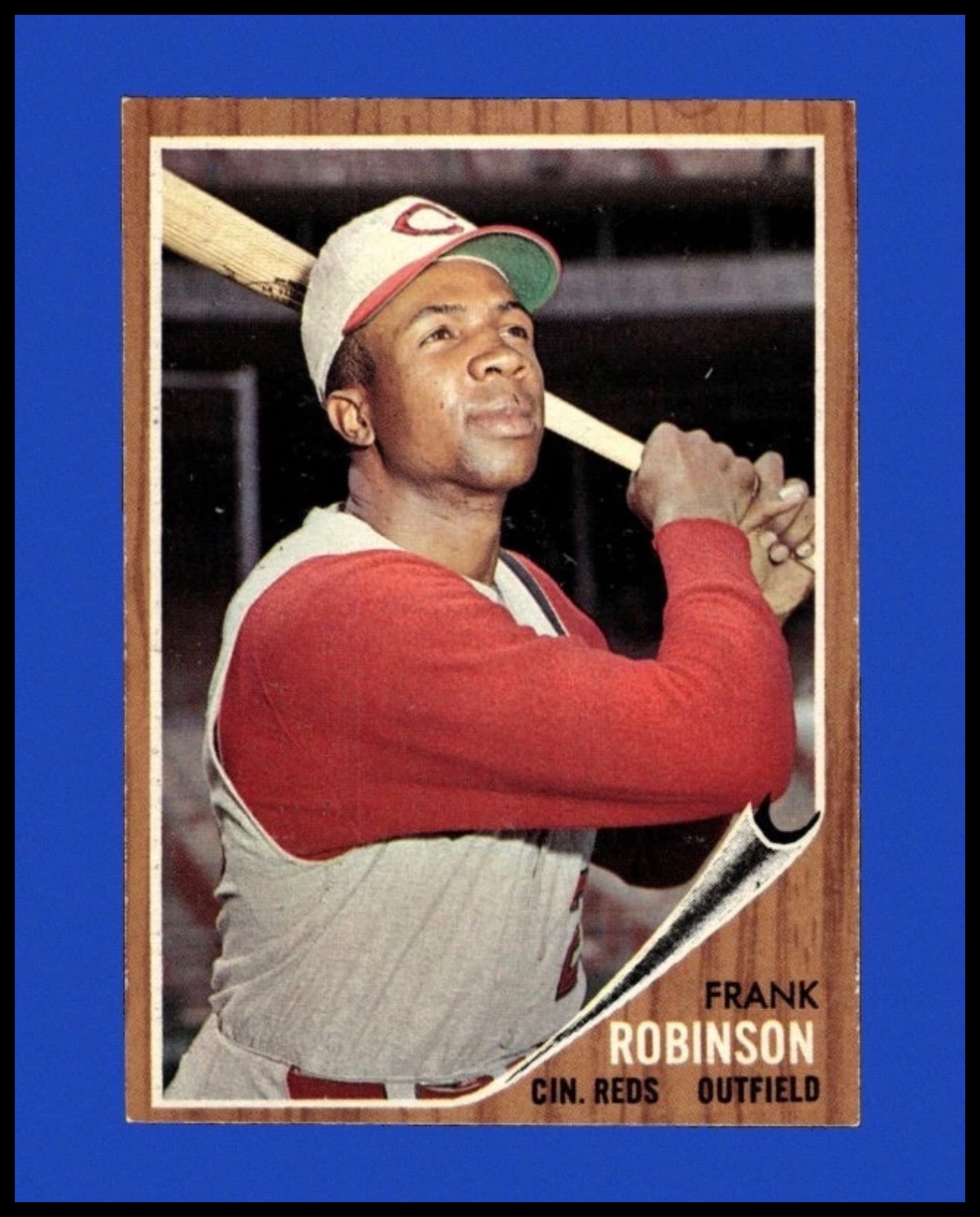
- This is Frank Robinson’s 1962 Topps base card, card number 350, and it is one of the key early-career cards for a Hall of Fame legend.
- The 1962 Topps design is widely collected for its colorful, horizontally oriented layout and large player photos.
- Frank Robinson is one of the most respected players in the hobby, so even common-vintage cards retain steady collector interest, especially in high grade.
Collector notes
Condition. For this card, centering is one of the biggest value drivers, along with sharp corners, clean edges, and strong surface gloss. Common vintage issues include off-centering, corner wear, print dots, light wax staining, edge chipping, and surface scratches. Because 1962 Topps cards often show visible print and cutting imperfections, higher grades are much tougher to find.
Storage. Store in a penny sleeve and rigid top loader or semi-rigid holder, then keep it in a cool, dry, stable environment away from sunlight and humidity. For high-grade copies, consider graded slabs or archival sleeves with minimal handling to preserve corners and surface.
Authenticity. Authentic 1962 Topps cards should show consistent vintage printing traits, aging appropriate to the cardboard, and correct back design and paper stock. Watch for overly bright paper, modern print patterns, cropped replicas, and incorrect gloss or color saturation. Comparing the front and back typography, edge wear, and stock thickness against known authentic examples is useful; for valuable copies, third-party grading from graded, graded, graded, or graded is recommended.