Market outlook
Stable Outlook 5/10
Demand should remain supported by Brooks Robinson's Hall of Fame status and long-standing popularity, but the card's common status and broad availability should keep pricing relatively stable rather than sharply rising.
Next months. Prices are likely to remain range-bound with modest movement tied mainly to grade, eye appeal, and auction timing.
Long term. Over 1-3 years, strong high-grade examples may appreciate gradually, but average copies should track a stable vintage-market pattern rather than outperforming scarcer Brooks Robinson issues.
History
Brooks Calbert Robinson Jr. was one of the defining third basemen in Major League Baseball history, spending his entire 23-season career with the Baltimore Orioles. Nicknamed "The Human Vacuum Cleaner" for his exceptional defense at third base, he became a Hall of Famer whose reputation rests on elite fielding, durability, and leadership as much as on his hitting. His career records for games played at third base, putouts, and assists at the position underscore why his name remains highly significant to baseball collectors and Orioles fans alike.[3]
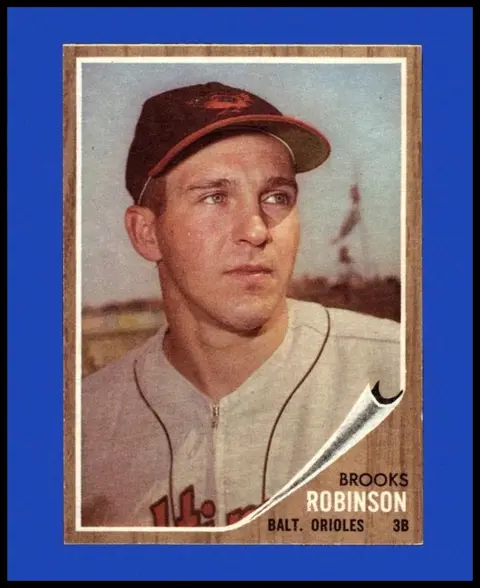
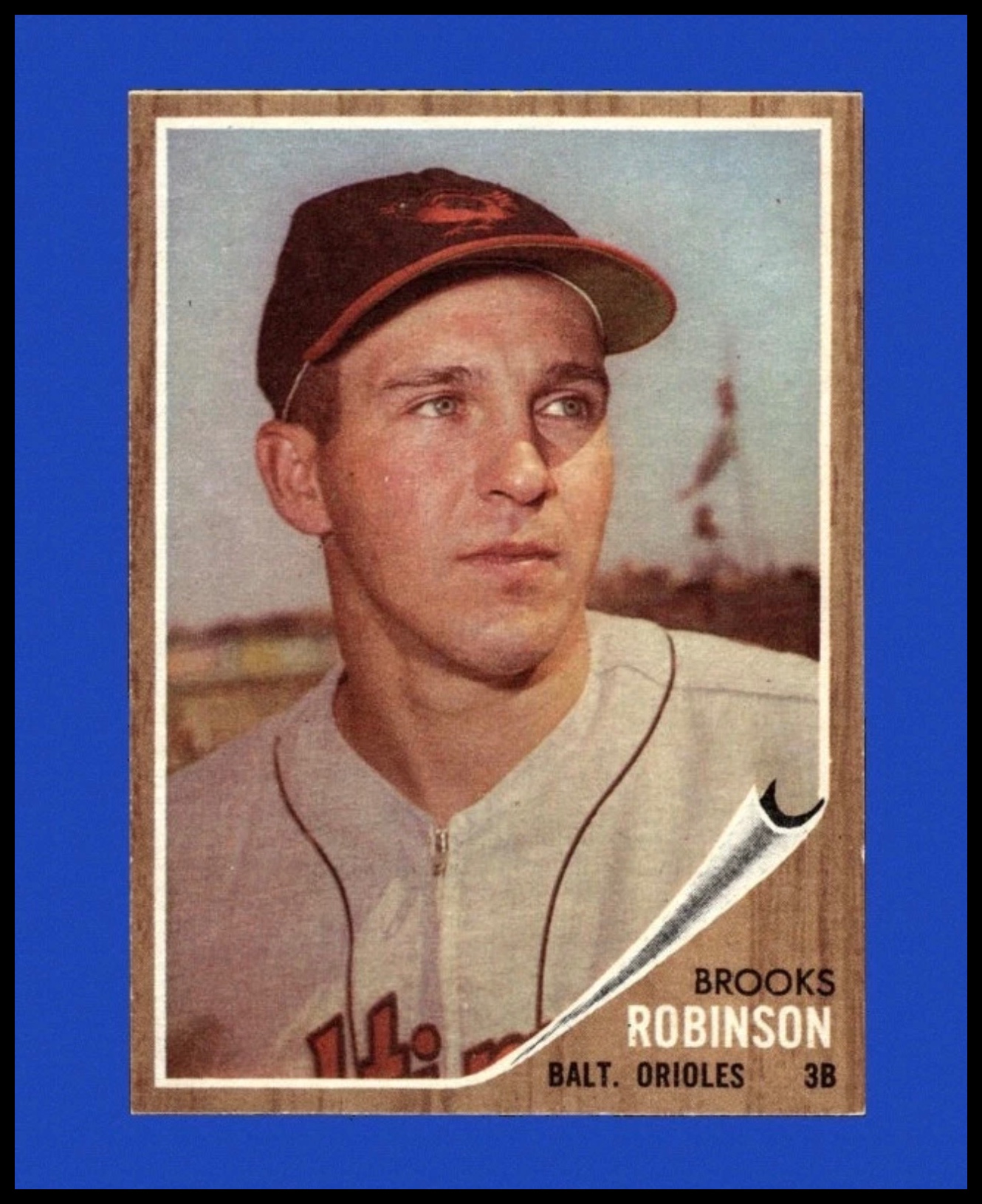
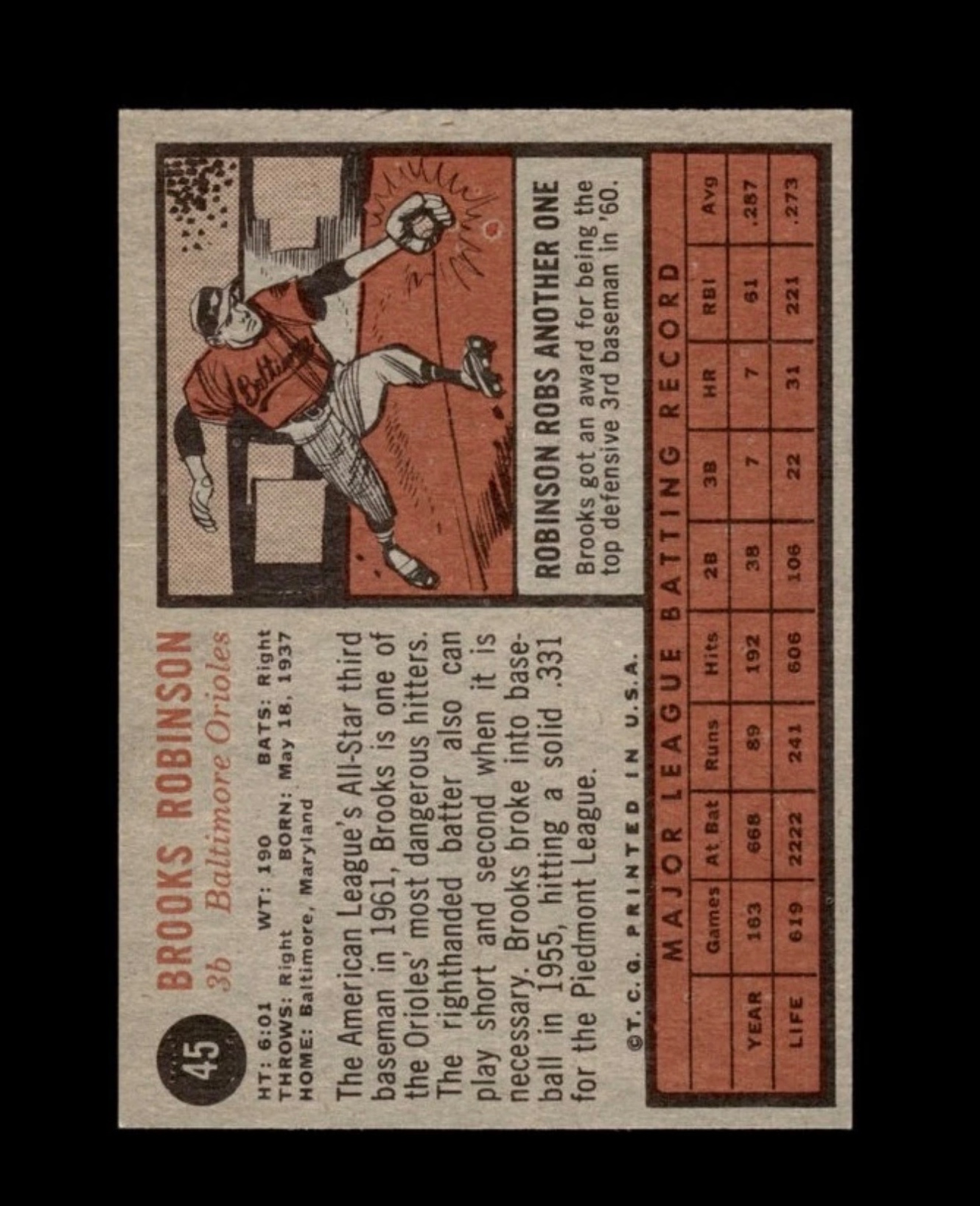
The 1962 Topps Brooks Robinson #45 was first issued in 1962 as part of Topps' 1962 baseball card set, a U.S. mass-market gum-card release distributed through retail and hobby channels nationwide.[4]
- The card is Brooks Robinson's 1962 Topps issue, card #45, and is commonly cataloged as a base card in the set.[2][4]
- Brooks Robinson appears in at least 124 baseball card sets overall, showing long-term collector demand and extensive checklist presence beyond this single issue.[1]
- Recent graded auction history for this card shows graded sales around the low hundreds of dollars, including graded 6 and graded 7 examples sold in May 2026.[5]
Collector notes
Condition. Check centering carefully, since 1960s Topps issues are often impacted by off-center printing. Look for corner wear, edge chipping, print defects, surface scratches, paper loss, wax staining, and color fading. Because this is a common vintage base card, sharp corners, strong centering, and clean surfaces materially improve value.
Storage. Store the card in an acid-free penny sleeve and semi-rigid holder or top loader, then keep it in a cool, dry, low-light environment. Avoid PVC plastics, high humidity, temperature swings, and direct handling of the surface. For higher-grade examples, use archival-grade holders and consider professional grading if condition appears strong.
Authenticity. Authentic 1962 Topps cards should show period-appropriate paper stock, vintage print characteristics, and consistent aging. Watch for overly bright stock, modern print dot patterns, suspiciously sharp edges on a card that should show age, and reprint gloss or color reproduction that looks too clean. Compare typography, registration, and back-print quality against known authentic examples; graded examples from major services reduce authenticity risk.