Market outlook
Stable Outlook 6/10
The base card remains a popular Hall-of-Fame-adjacent era rookie with consistent nostalgia demand, but huge population counts keep prices from moving sharply. Tiffany and high-grade examples are better positioned for selective appreciation.
Next months. Expect mostly sideways pricing with small fluctuations based on grade, auction timing, and grading population changes.
Long term. Likely gradual appreciation at a modest pace, especially for graded 10 and Tiffany copies, while raw base copies should remain affordable and relatively stable.
History
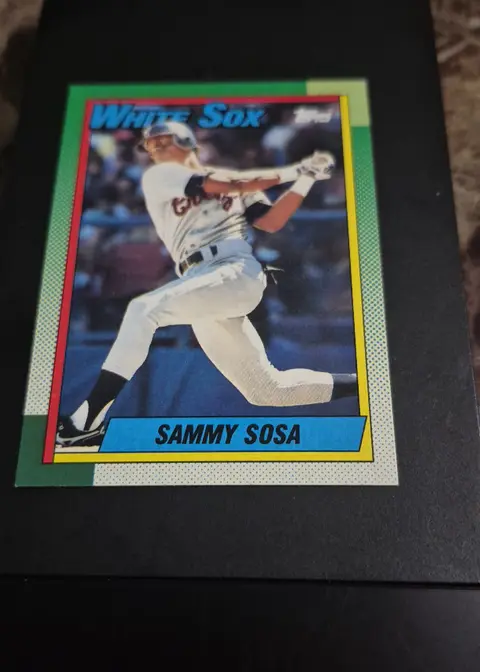
Sammy Sosa is a Dominican-born Major League Baseball outfielder who became one of the most recognizable sluggers of the 1990s and early 2000s. Signed by the Texas Rangers as an amateur free agent in 1985, he debuted in MLB in 1989 and later became a superstar with the Chicago Cubs, most famously during the 1998 home run chase. His 1990 Topps rookie card is one of the key early mainstream cards from the era and is widely collected because it represents an iconic player at the start of his career.
First released in 1990 as part of Topps Baseball Series 1/2 distribution in the United States. The base card was printed in the standard 1990 Topps flagship baseball set, with additional premium Tiffany versions produced for a smaller collector market.
- Card number 692 is widely recognized as Sammy Sosa’s main 1990 Topps rookie card.
- The standard 1990 Topps version is a mass-produced common, while the Tiffany version is scarcer and more valuable.
- Collectors often note the small printing differences between standard Topps and Tiffany, including the trademark line on the back; the Tiffany version omits the “E*” marking mentioned by some reference guides.
Collector notes
Condition. Centering is one of the biggest value drivers, followed by sharp corners, clean edges, and a flaw-free surface. Common issues include wax/stain marks, print defects, corner whitening, and off-centering. Because this is a heavily handled common-era card, gem mint copies are much scarcer than raw examples.
Storage. Store in a penny sleeve and rigid top loader or semi-rigid holder, keep away from humidity and direct sunlight, and avoid pressure on corners. For higher-grade copies, consider professional grading and archival storage to protect long-term value.
Authenticity. The standard Topps card should match the 1990 flagship design, while Tiffany versions have a glossier premium stock and set-specific back differences. Compare card stock, gloss, color clarity, and back trademark markings. Reprints and altered cards are usually detectable by paper quality, print sharpness, and inconsistent gloss or edges. When in doubt, buy graded examples from reputable third-party graders.