Market outlook
Rising Outlook 7/10
Growing collector interest in iconic 1960s rookie cards and Dick Allen's legacy as a trailblazer. High-grade copies remain scarce, driving prices upward [1][2]
Next months. Next 3–6 months: Prices for NM-MT 8 and MINT 9 grades expected to rise 5–10% due to auction demand and limited supply [1]
Long term. 1–3 years: Continued appreciation for high-grade copies, especially as Allen's legacy is further cemented in baseball historiography; potential for 20–30% growth in top grades [1]
History
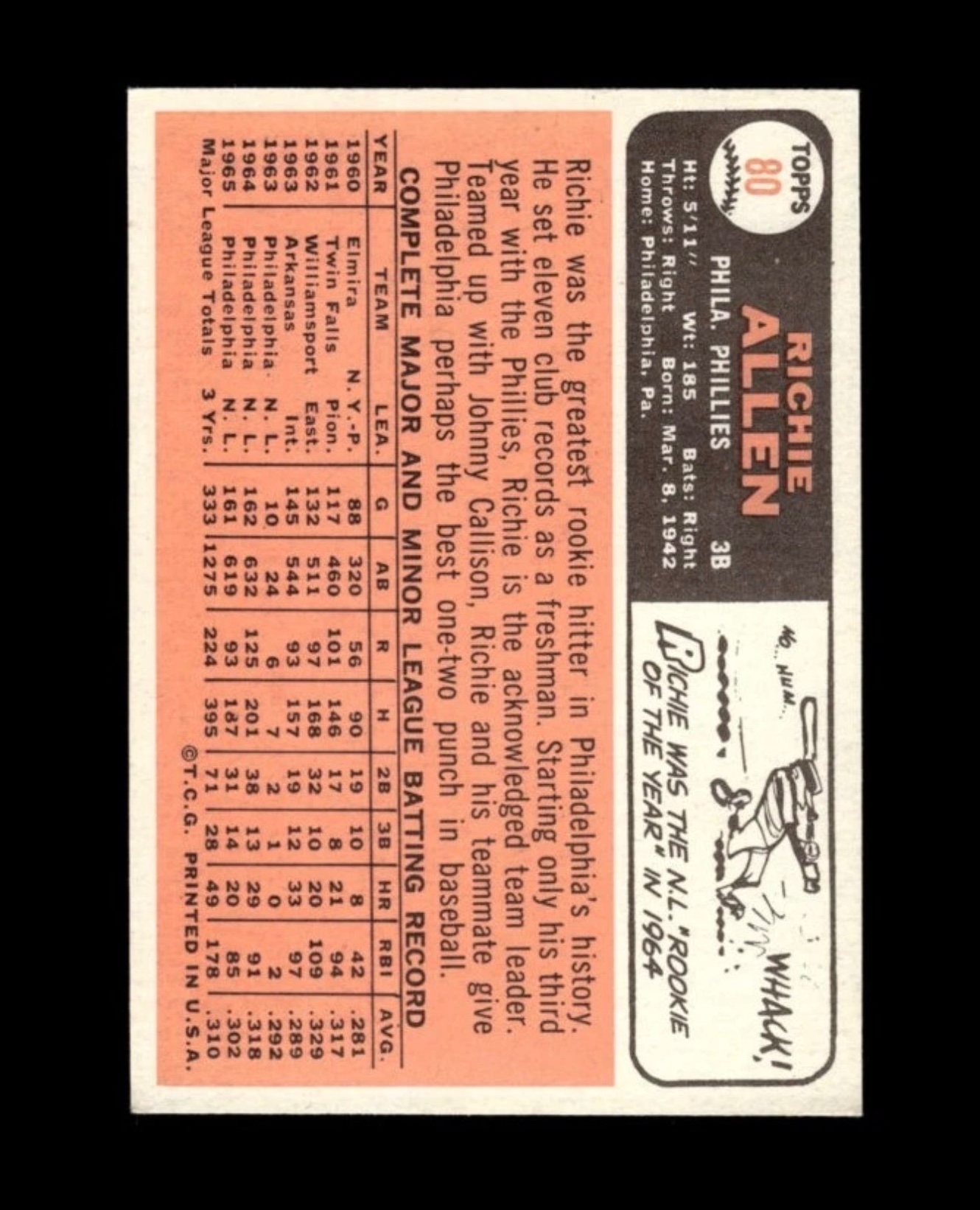
Richie Allen (correctly spelled Dick Allen) was one of the most talented and controversial baseball players of the 1960s. Selected by the Philadelphia Phillies in the 1963 draft, he made his MLB debut in 1963 and became the 1964 NL Rookie of the Year. His powerful batting, aggressive style, and the racial tensions surrounding his fame as a Black player in a largely white-dominated sport made him a polarizing figure. He played for the Phillies, St. Louis Cardinals, Chicago White Sox, and Los Angeles Dodgers during his career [2].
This card was first released in 1965 as part of the 1965 Topps Baseball set in the United States. It was issued as Richie Allen's 'All-Star Rookie' card, numbered 460, not 80 [1][2].
- Dick Allen won the 1964 National League Rookie of the Year Award [1]
- His 1965 Topps card is one of the most iconic rookie cards of the 1960s [1]
- Allen was the first Black player to receive significant media attention in Philadelphia, leading to both immense support and intense hostility [2]
Rarity and print run
- Tier
- Common
- Print run
- Very High
- First printed in
- 1965 Topps Baseball
- Demand
- High
- Supply
- Medium
- Massively produced in 1965 Topps set, making it very common in low grades
- High-grade copies (graded 8+) are significantly scarcer due to soft corners and centering issues [1]
- Only one official printing in the 1965 set
Collector notes
Condition. Key flaws include soft corners, especially on the front right corner, centering issues (common in 1965 Topps), and wear on the edges. The card's white border is prone to creasing and discoloration. Check for print spots and gum stain on the back [1][5].
Storage. Store in a rigid, non-PVC card sleeve, placed inside an acid-free top loader. Keep in a climate-controlled environment away from direct sunlight and humidity. Avoid stacking cards without protection [1][5].
Authenticity. Fakes often have incorrect card numbering (e.g., 80 instead of 460), incorrect font, or off-center printing. Reprints may lack the original paper texture or have overly bright colors. Authenticate by checking the graded or graded certification number and comparing to known condition census data [1][7].
Sources: psacard.com, gocollect.com, sportscardspro.com, collectibles.com, deanscards.com