Market outlook
Stable Outlook 7/10
The card benefits from enduring Hall of Fame demand and steady vintage baseball interest, while its large original supply keeps lower-grade pricing from being especially volatile.[2][3][5][8]
Next months. Over the next 3-6 months, prices are likely to remain stable with modest movement tied to vintage baseball market strength and auction visibility.
Long term. Over 1-3 years, high-grade copies should remain resilient or gradually appreciate, while raw and low-grade copies are likely to track broader vintage market trends more closely.
History
Johnny Bench, born Johnny Lee Bench on December 7, 1947, is one of the most celebrated catchers in Major League Baseball history and a cornerstone of the Cincinnati Reds' Big Red Machine era.[2] He became a Hall of Famer and is widely regarded as one of the greatest defensive catchers ever, with major significance to baseball history because he helped redefine the catcher position through elite defense, strong throwing, and middle-of-the-order power.[2][5]
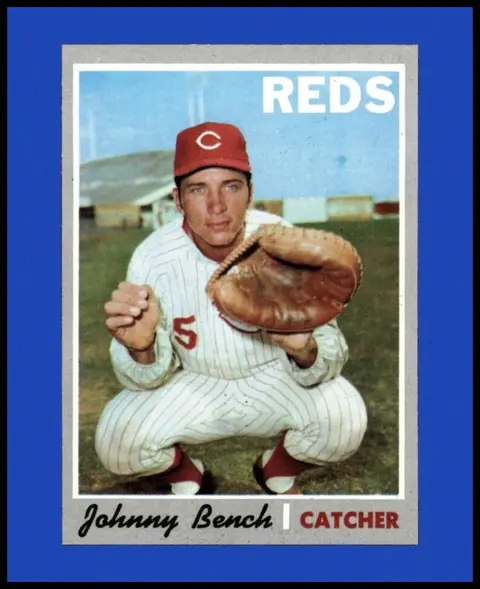
This card was first issued in the 1970 Topps Baseball set by Topps in 1970, as card #660, part of the standard U.S. release for that year.[2][4]
- This is Johnny Bench's 1970 Topps base card, one of the most recognized early-catalog cards of a Hall of Fame catcher.[2][4]
- graded lists this card with a strong market and a very small population at the highest grade, including only four graded Gem Mint 10 copies in its population data.[2]
- The card is commonly discussed by collectors as a key Bench issue and a widely collected 1970s Topps Hall of Fame card rather than a true scarcity card.[2][5]
Collector notes
Condition. Check centering carefully, as 1970 Topps cards are often off-center; also inspect corner wear, edge chipping, surface print defects, and wax/stain issues typical of vintage Topps cards.[2][3] High-grade copies are especially sensitive to registration, clean borders, and sharp corners because even minor flaws can reduce grade sharply.[2][3]
Storage. Store the card in a penny sleeve and semi-rigid or top-loader, keep it in a cool, dry, low-light environment, and avoid PVC plastics or loose storage that can cause edge wear. For long-term preservation, use archival-quality holders and handle the card only by the edges.
Authenticity. Authentic 1970 Topps cards should show period-correct stock, printing texture, and aging characteristics; suspiciously bright borders, overly sharp corners, or modern gloss can indicate reprints. Third-party authentication from graded, graded, or graded is the safest way to verify authenticity, especially for high-grade examples.[1][2][3]