Market outlook
Stable Outlook 7/10
Modern Japanese chase cards for iconic Pokémon usually settle into a stable band after initial release volatility, especially when supply remains adequate and multiple print variants exist. Strong character demand should support the card, but the market is unlikely to surge dramatically unless sealed product tightens or Gengar receives renewed attention.
Next months. Likely to trade in a relatively narrow range, with small swings based on grade, population updates, and set nostalgia.
Long term. Over 1-3 years, the card should remain collectible and liquid, with modest appreciation possible if high-grade supply tightens and Gengar stays a top fan-favorite character.
History
Gengar is a long-running Pokémon species introduced in Generation I, known as the evolved form of Haunter and the final evolution of Gastly. Mega Gengar ex represents Gengar’s Mega Evolution era design, emphasizing its ghostly, prankster-like, and predatory aesthetic that made it one of the most popular and recognizable Pokémon among collectors and competitive players.
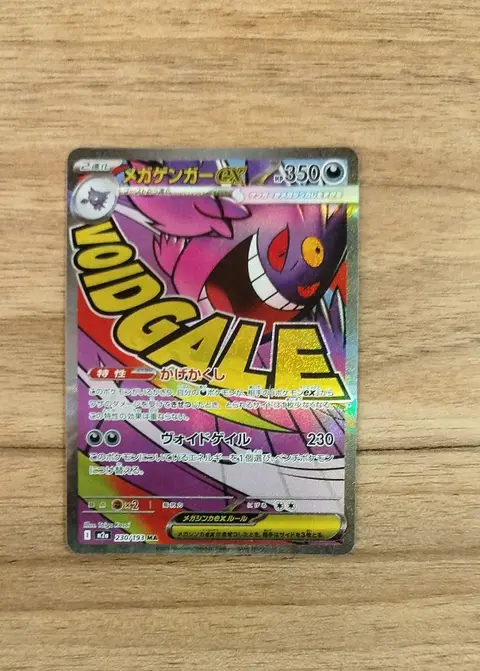
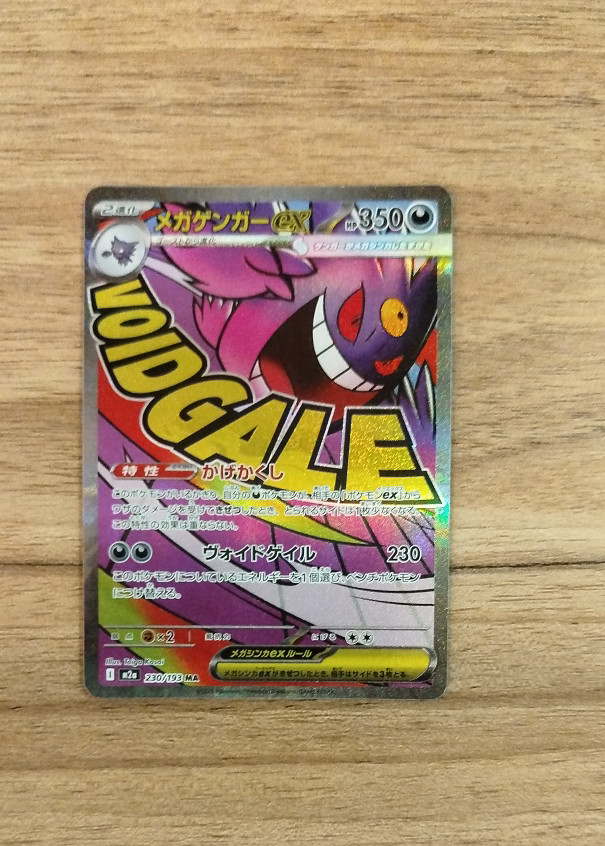
The Japanese printing identified by 230/193 was released in the 2025 Japanese high-class set MEGA Dream ex (M2a), not in 2024; retailer listings and card databases identify it as メガゲンガーex【MA】{230/193} [M2a].
- This card is classified as a Mega Attack Rare (MA), which is a Japanese high-rarity parallel style within MEGA Dream ex.
- The same character also appears in at least two other Japanese printings: a MEGA Starter Set version and a SAR version from the same MEGA Dream ex era.
- Some secondary-market listings have misdated or inconsistently labeled the card as 2024 or 2025, but the 230/193 MA printing is tied to the M2a MEGA Dream ex release.
Rarity and print run
- Tier
- Secret Rare
- Print run
- High
- First printed in
- MEGA Dream ex (M2a)
- Demand
- High
- Supply
- Medium
- It is a high-rarity Japanese chase card from a modern high-class set.
- Condition-sensitive full-art/texture-style cards see fewer strong raw copies.
- Collector demand is amplified by Gengar’s popularity and by multiple parallel versions in the same product cycle.
Collector notes
Condition. Check for whitening on edges and corners, surface scratches on the holo/full-art finish, centering issues, and print lines or roller marks that are common on modern Japanese high-rarity cards. For raw copies, watch for corner dings from factory packaging and handling marks on the dark background.
Storage. Store in a penny sleeve and rigid top loader or semi-rigid holder immediately, keep away from humidity and heat, and avoid friction that can scratch the textured or holographic surface. For long-term value, slab grading is often preferred for high-end Japanese chase cards.
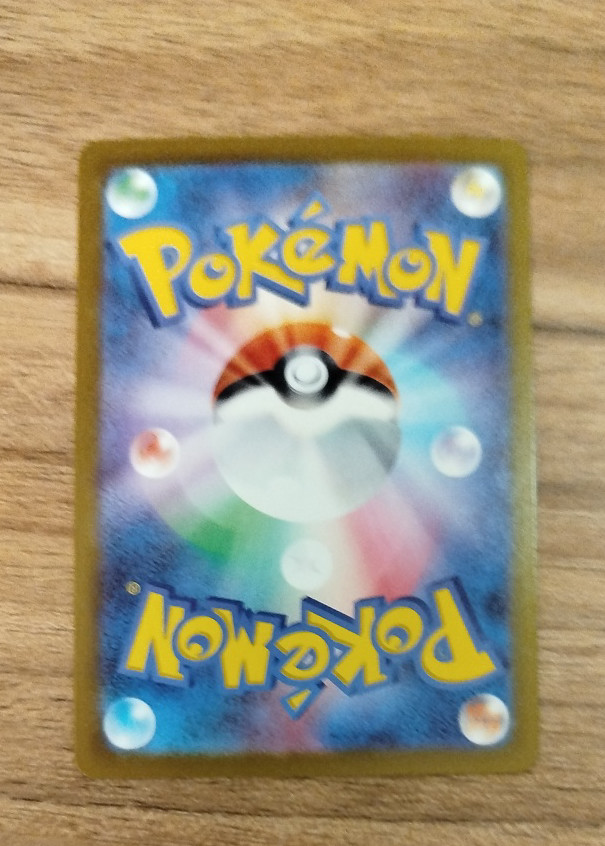
Authenticity. Authentic Japanese copies should have crisp text, precise printing, and the correct 230/193 numbering with MEGA Dream ex-era styling. Watch for poor color saturation, blurry typography, misaligned borders, incorrect texture patterns, or fake holo effects; compare the exact card number, Japanese set markings, and surface texture against verified examples.
Sources: cardrush-pokemon.jp, shop.tiktok.com, scrydex.com, samuraiswordtokyo.com, magicardshop.jp