Market outlook
Rising Outlook 8/10
The card benefits from sustained Hall of Fame demand, strong flagship-set recognition, and a long-term collector base for Willie Mays and 1960s Topps stars. High-grade population scarcity and ongoing interest in iconic first-card set numbers also support appreciation.
Next months. Likely stable to modestly higher pricing, with the strongest movement in high-grade certified examples.
Long term. Likely gradual appreciation over 1-3 years, especially for graded 8-10 copies and well-centered examples.
History
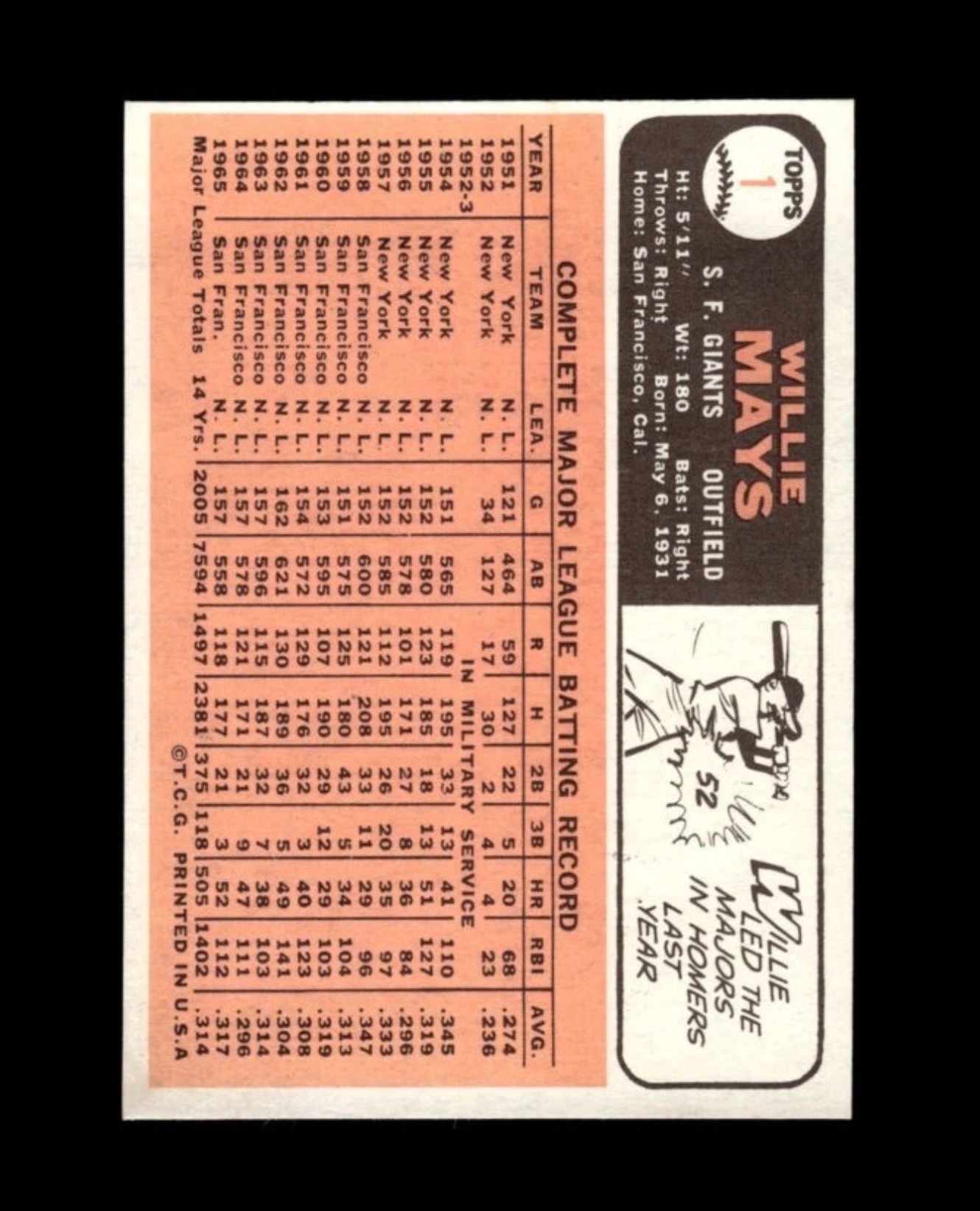
Willie Mays was one of the greatest all-around baseball players in history, a Hall of Fame center fielder whose combination of power, speed, defense, and iconic over-the-shoulder catches made him one of the sport’s defining stars. By 1966, he was already an established legend and the centerpiece of the San Francisco Giants, so his Topps card reflects both his superstar status and his value as a flagship player in the hobby.
The card was first released in the 1966 Topps Baseball set, issued by Topps in the United States as part of the 1966 baseball card release.
- This is card number 1 in the 1966 Topps Baseball set, which makes it one of the set’s most recognizable and sought-after cards.
- The 1966 Topps Willie Mays #1 is a standalone player card, while Topps also included Mays in a multi-player NL Home Run Leaders card in the same year.
- Available market data shows strong collector demand for high-grade examples, with graded 9 sales reported at very high levels and even mid-grade copies carrying meaningful value.
Collector notes
Condition. Check for centering, as 1960s Topps issues are often judged heavily on left-right and top-bottom alignment. Also inspect corners for whitening, surface wear, print snow, wax/stain marks, and edge chipping, since the bright borders and card stock show flaws easily. High-grade examples are especially sensitive to color freshness and clean surfaces.
Storage. Store the card in a penny sleeve inside a rigid top loader or semi-rigid holder for protection, and keep it in a cool, dry, low-light environment. For higher-value copies, use archival-quality materials and avoid PVC sleeves, moisture, and repeated handling.
Authenticity. Authentic examples should show period-correct 1966 Topps printing characteristics, including consistent cardstock, sharp but not modern digital-looking print dots, and age-consistent wear. Reprints often appear too glossy, too clean, or have mismatched paper stock; compare card stock thickness, color tone, and print registration against known originals when possible. For valuable copies, third-party grading is the safest authentication route.