Market outlook
Stable Outlook 7/10
The card benefits from steady Hall of Fame demand and strong interest in high-grade vintage Topps, but it lacks the scarcity profile of a rookie, short print, or special parallel. Pricing is therefore likely to remain supported rather than explosive.
Next months. Expect mostly stable pricing with grade-based movement, especially if more graded 8-9 examples trade publicly.
Long term. Over 1-3 years, gradual appreciation is plausible for high-grade copies, while lower-grade copies should remain relatively liquid but modest in value.
History
Frank Robinson was one of baseball’s most accomplished all-around players and a pioneering figure in the sport. By 1965, when this card was issued, he was already an established star with the Cincinnati Reds, noted for elite power, disciplined hitting, speed, and strong defense. graded notes that Robinson was a 14-time All-Star, a two-time World Series champion, and a 1958 Gold Glove winner; he later became the first African American manager in Major League Baseball in 1975.[3]
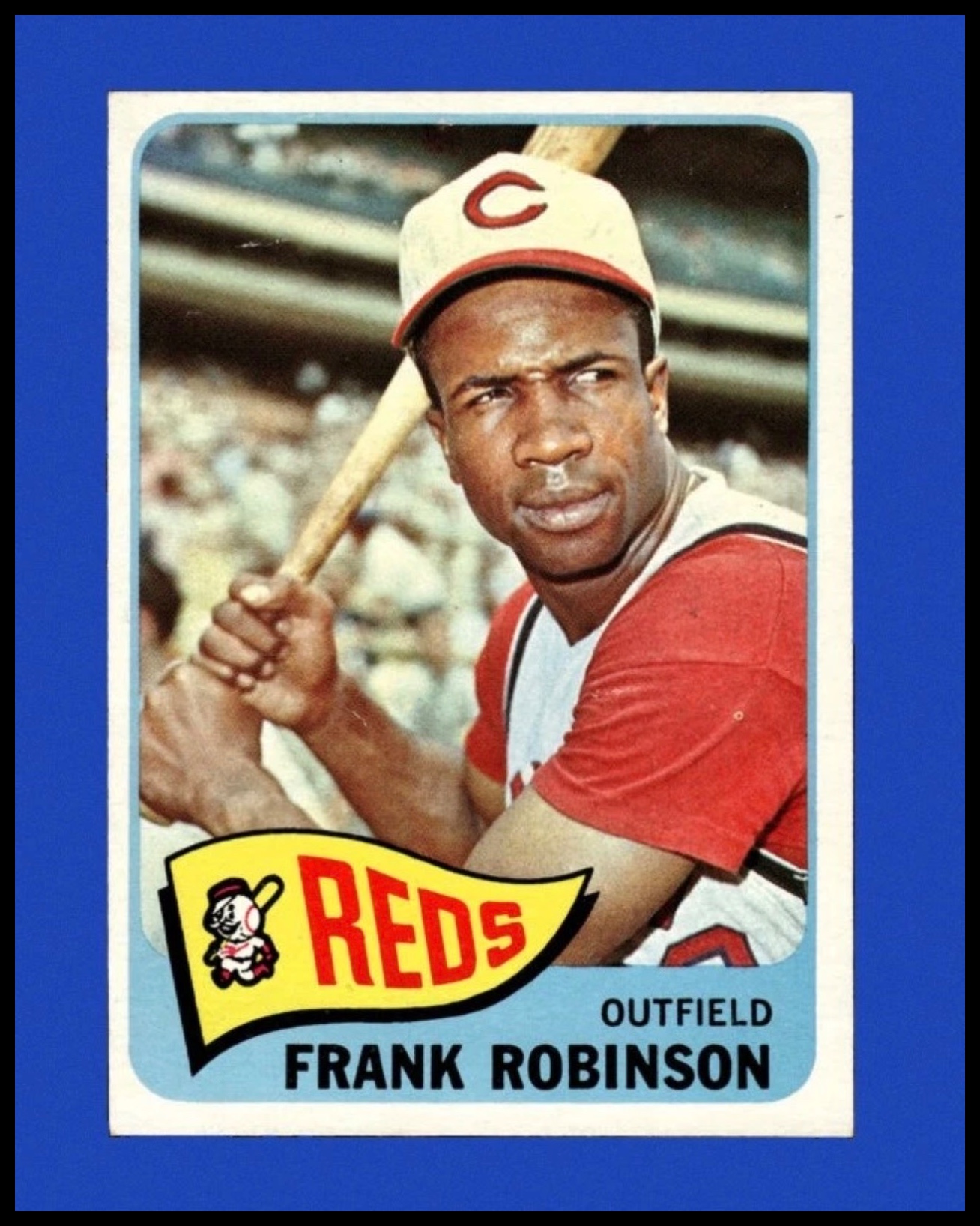
This card was first released in the 1965 Topps Baseball series, a nationally distributed U.S. trading card set issued by Topps during the 1965 baseball season.[6]
- Card number 120 in the 1965 Topps Baseball set features Frank Robinson as a Cincinnati Reds player.[6]
- Frank Robinson is one of the most significant Hall of Fame players of the 1960s era and is widely collected across his key rookie and star-era cards.[3][7]
- This card is part of a large mainstream Topps base set, so it is more collectible for player significance and condition scarcity than for pack-level rarity.[6]
Rarity and print run
- Tier
- Common
- Print run
- Very High
- First printed in
- 1965 Topps Baseball
- Demand
- High
- Supply
- High
- It was issued as a mainstream base card in a very large Topps production run.
- High-grade examples are harder to find because 1960s Topps cards often suffer from centering and corner issues.
- Collector demand is driven more by player importance than by print scarcity.
Collector notes
Condition. Check for centering, corner wear, edge chipping, print snow, surface scratches, and any wax staining or discoloration. Cards from 1965 Topps are especially prone to off-centering and soft corners, and high-grade copies are much scarcer than raw examples suggest.
Storage. Store in a penny sleeve and rigid top loader or semi-rigid holder, keep in a cool dry environment, and avoid pressure, moisture, and direct light. For higher-value graded candidates, handle only by edges and consider professional grading if the card appears clean and well-centered.
Authenticity. Verify correct 1965 Topps card stock, printing quality, and vintage aging patterns. Reprints often look too crisp, have unnatural gloss or color, or lack the paper texture and aging seen on originals; compare front and back fonts, registration, and border wear, and use third-party grading for valuable copies.
Sources: sportlots.com, sportscardinvestor.com, psacard.com, sportscardspro.com, throwbacksportscards.com